SEO Optimized Article | Automotive Guide | Beginner Friendly
Choosing between motorcycle disc brakes and drum brakes is an important decision for anyone buying a new motorcycle or learning about motorcycle maintenance. Both braking systems are designed to slow down and stop a motorcycle, but they work differently and offer different advantages.
In my view, understanding the difference between motorcycle disc brakes vs drum brakes can help riders make a more informed decision. Braking performance, maintenance costs, durability, riding conditions, and the price of a motorcycle are all factors worth considering before choosing one system over the other.
Some motorcycles use disc brakes on both wheels, while others combine a front disc brake with a rear drum brake. Many budget friendly motorcycles still use drum brakes because they are relatively simple and affordable. Meanwhile, disc brakes are widely used on motorcycles that require stronger braking performance and better heat management.
In this article, I will explain how motorcycle disc brakes and drum brakes work, compare their advantages and disadvantages, and discuss which braking system may be the better choice for different riders.
What Are Motorcycle Disc Brakes?
Motorcycle disc brakes are a braking system that uses a metal disc, commonly called a rotor, attached to the wheel. When the rider presses the brake lever or pedal, brake pads squeeze the rotating disc and create friction. This friction slows down the wheel and helps bring the motorcycle to a stop.
Most modern motorcycles with front disc brakes use a hydraulic system. When the rider presses the brake lever, brake fluid transfers pressure to a caliper, which pushes the brake pads against the disc.
One of the main advantages of motorcycle disc brakes is their ability to manage heat. Braking creates heat because the system converts the motorcycle’s movement into thermal energy. Since the disc is exposed to the surrounding air, it can release heat relatively efficiently.
Disc brakes are particularly useful for motorcycles that travel at higher speeds, carry heavier loads, or frequently encounter demanding traffic conditions. However, actual braking performance depends on several factors, including tire grip, brake quality, road conditions, and the motorcycle’s overall design.
What Are Motorcycle Drum Brakes?
Motorcycle drum brakes use a different design. Instead of squeezing a disc from the outside, the system contains curved brake shoes inside a round metal drum attached to the wheel.
When the rider applies the brake, a mechanical linkage or another operating mechanism pushes the brake shoes outward against the inner surface of the drum. The resulting friction slows down the wheel.
Drum brakes are known for their relatively simple construction. They can be economical to manufacture and are often found on commuter motorcycles and entry level models.
Another benefit is that many of their working components are enclosed inside the drum. This provides some protection from direct exposure to water, dust, and road debris, although the system can still be affected by moisture, contamination, and wear.
In my opinion, drum brakes remain a practical option for everyday commuting when the motorcycle is designed for moderate speeds and regular maintenance is performed. Their suitability still depends on the vehicle’s specifications and intended use.
Motorcycle Disc Brakes vs Drum Brakes: Main Differences
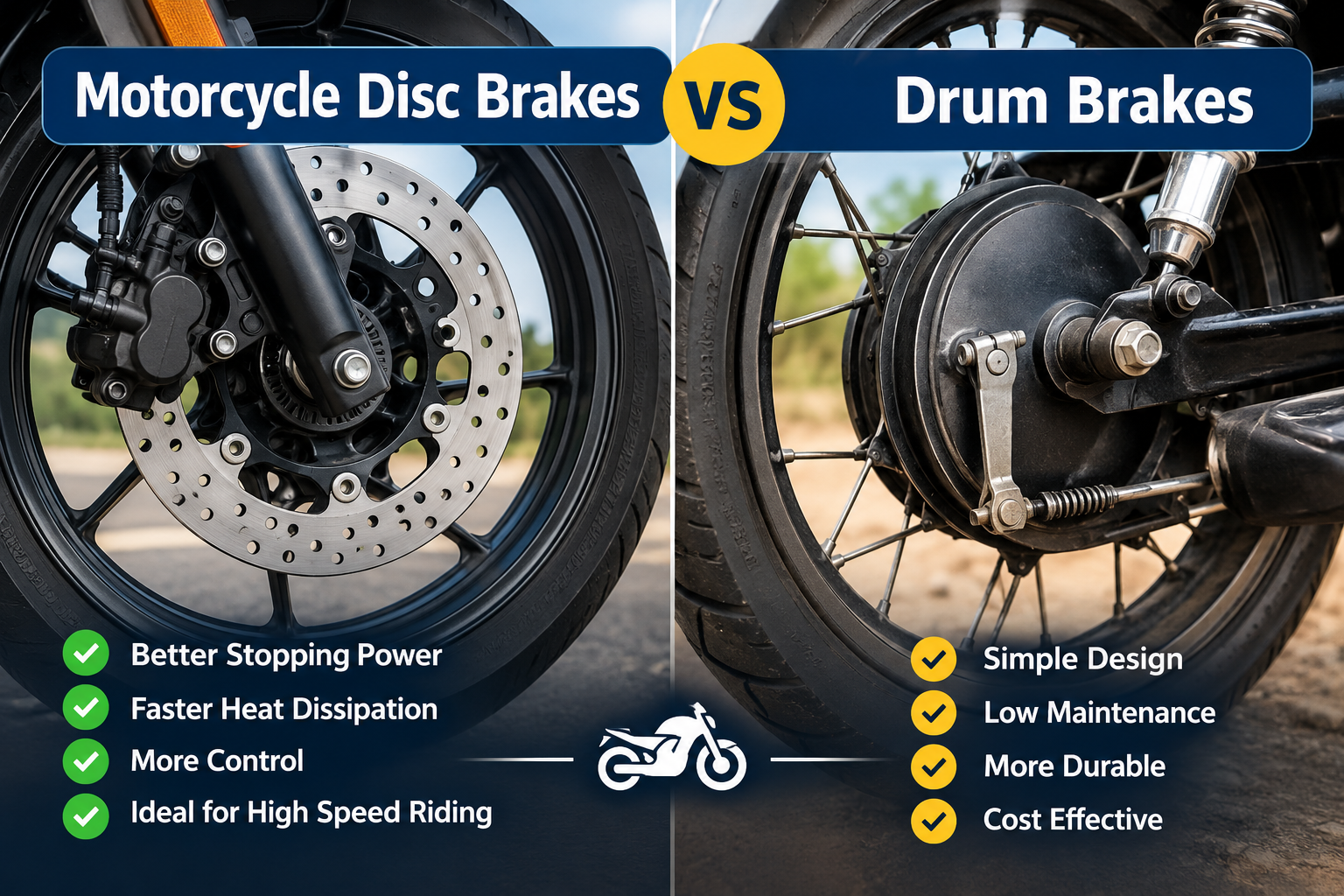
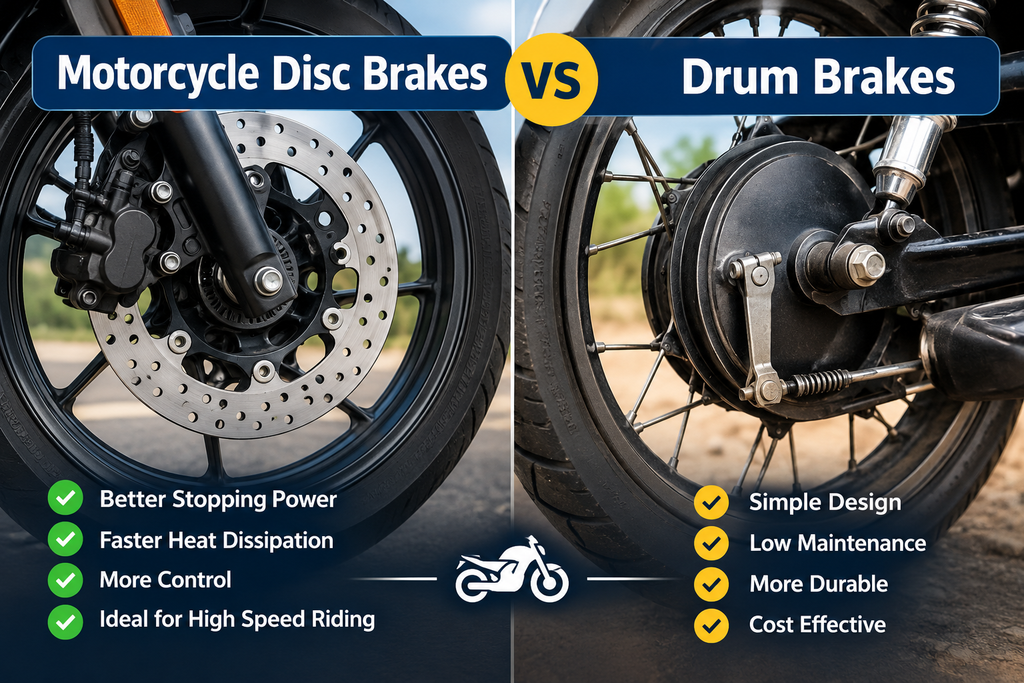
The most noticeable difference between these braking systems is how they create friction. Disc brakes squeeze pads against an exposed rotor, while drum brakes push shoes against the inside of a drum.
Here is a simple comparison of the two systems.
| Feature | Disc brakes | Drum brakes |
|---|---|---|
| Braking design | Pads squeeze a disc | Shoes press against a drum |
| Heat dissipation | Generally better | Generally more limited |
| Performance under repeated braking | Often more consistent | More susceptible to heat related fading |
| Maintenance | May require more specialized service | Mechanically simple, but adjustment and shoe replacement are needed |
| Typical purchase cost | Often higher | Often lower |
| Wet weather response | Usually good, but depends on conditions | Can be affected by moisture inside the drum |
| Common applications | Front brakes, performance motorcycles, many modern models | Rear brakes and economical commuter motorcycles |
Neither system automatically makes every motorcycle safer. The quality of the components, maintenance, tires, and rider behavior all influence how effectively a motorcycle stops.
1. Braking Performance: Which Stops Better?
Braking performance is one of the most important differences when comparing motorcycle disc brakes vs drum brakes. Disc brakes generally offer stronger and more consistent braking under demanding conditions, especially when a motorcycle needs to slow down repeatedly.
The exposed rotor allows heat to escape more easily, helping the braking system maintain its performance during repeated braking. This can be particularly helpful in busy city traffic, on hilly roads, or during longer rides.
Drum brakes can also provide effective stopping power when correctly designed and maintained. However, their enclosed construction can make heat dissipation less effective during repeated heavy braking. Excessive heat may reduce braking effectiveness, a condition known as brake fade.
For everyday commuting at moderate speeds, a properly maintained drum brake can be adequate. For riders who regularly travel at higher speeds or carry passengers and luggage, a well designed disc brake system can offer valuable advantages.
It is important to remember that stopping distance also depends on tire condition, road grip, rider technique, and the motorcycle’s weight. A disc brake does not guarantee a shorter stopping distance in every situation.
2. Heat Dissipation and Brake Fade
Heat management is another important factor in the motorcycle disc brakes vs drum brakes comparison.
When a motorcycle slows down, its brakes convert kinetic energy into heat. If that heat builds up faster than the system can release it, braking performance may decrease.
Disc brakes are generally better at releasing heat because the rotor is exposed to airflow. Some rotors also feature holes or other design elements intended to assist cooling or manage water and debris.
Drum brakes keep most of their friction surfaces inside a metal housing. This protects the components from direct exposure, but it can also limit cooling during repeated braking.
From my perspective, heat management matters most when choosing a motorcycle for demanding riding rather than occasional short trips. For ordinary commuting, either system can work well if used within its intended limits.
3. Maintenance and Repair Costs
Maintenance costs can influence the overall ownership experience of a motorcycle.
Disc brakes usually require inspection of the brake pads, rotor thickness, caliper operation, and, for hydraulic systems, brake fluid condition. The brake pads gradually wear out and need replacement. The rotor may also require replacement if it becomes excessively worn, damaged, or warped.
Hydraulic disc brakes need additional attention to fluid condition and potential leaks. Any unusual lever feel, reduced braking performance, or fluid leakage should be inspected by a qualified mechanic.
Drum brakes typically have brake shoes, return springs, and an operating mechanism that need periodic inspection. Depending on the design, the brake may require adjustment as the shoes wear. The drum and internal components also need cleaning and inspection when servicing is due.
In many budget motorcycle models, drum brakes can be cheaper to manufacture and maintain. However, the real cost depends on the motorcycle model, replacement parts, labor charges, and local availability.
My recommendation is to compare the actual service costs of the motorcycles you are considering rather than assuming that every drum brake is cheaper to maintain.
4. Performance in Rainy and Dusty Conditions
Road conditions can affect both motorcycle disc brakes and drum brakes.
Disc brakes have exposed friction surfaces, which means water can temporarily affect braking response when riding through rain or standing water. They generally clear water effectively during normal operation, but riders should always allow for changing road grip and braking conditions.
Drum brakes offer more protection because their friction components sit inside an enclosed housing. However, water or dirt that enters the assembly can still affect performance. Moisture may also contribute to corrosion when a motorcycle remains unused for long periods.
Dusty roads create additional challenges. Dirt can accumulate around either braking system, so routine inspection and proper servicing are important.
For riders in areas with changing weather and dusty roads, I would focus on the overall quality of the braking system, tire condition, and maintenance schedule. Neither system removes the need for careful riding.
5. Which Brake System Is Better for Daily Commuting?
For daily commuting, the best choice depends on the type of motorcycle and the conditions in which it is used.
Drum brakes are common on economical commuter motorcycles because they help keep purchase prices affordable. They can be suitable for regular short trips, moderate speeds, and everyday transportation.
Disc brakes are useful for riders who encounter frequent traffic, unexpected stops, or roads where stronger and more consistent braking is important. A front disc brake can be particularly beneficial because braking transfers weight toward the front wheel, increasing the front tire’s share of the braking load.
For many riders, a motorcycle with a front disc brake and a rear drum brake provides a practical balance between performance and cost. This combination is common on some commuter motorcycles, although availability varies by model and market.
I would not choose a motorcycle based only on the brake type. Engine size, tire quality, suspension, riding position, safety equipment, and the availability of spare parts are also worth checking.
6. Advantages and Disadvantages of Disc Brakes
Disc brakes offer several important benefits, but they also have limitations.
Advantages of disc brakes
- Better heat dissipation during repeated braking.
- Generally consistent performance under demanding conditions.
- Effective braking response when the components are in good condition.
- Easier visual inspection of many brake components.
- Suitable for a wide range of motorcycles, including performance models.
Disadvantages of disc brakes
- Some systems have higher initial manufacturing and repair costs.
- Brake pads and rotors require periodic inspection and replacement.
- Hydraulic components require proper servicing.
- Exposed components may be vulnerable to damage from impacts or corrosion.
These points explain why disc brakes are widely used on modern motorcycles, but the quality of the complete system matters more than the presence of a disc alone.
7. Advantages and Disadvantages of Drum Brakes
Drum brakes remain useful because they provide a straightforward and economical braking solution.
Advantages of drum brakes
- Simple mechanical construction in many designs.
- Often lower purchase cost.
- Enclosed components receive some protection from road debris.
- Can provide dependable braking when properly maintained.
- Practical for many budget commuter motorcycles.
Disadvantages of drum brakes
- Generally less effective at dissipating heat during repeated heavy braking.
- Internal components can be harder to inspect without opening the assembly.
- Performance can decline when the system becomes excessively hot.
- Brake shoe adjustment and replacement are necessary as components wear.
These disadvantages do not mean drum brakes are unsuitable for every motorcycle. They simply make it important to match the system to the motorcycle’s intended use.
8. How to Choose the Right Motorcycle Brakes
Before buying a motorcycle, I recommend considering the following factors.
Your riding speed: If you regularly travel on highways, a motorcycle with a well designed disc brake system may be a better fit.
Your daily route: Busy roads, steep slopes, and frequent stops can place greater demands on the braking system.
Your budget: Compare the total motorcycle price, replacement parts, and routine service costs.
Safety features: Check whether the motorcycle includes ABS, or an anti lock braking system, where available. ABS helps prevent wheel lock during hard braking, but it does not eliminate every risk or guarantee shorter stopping distances in all conditions.
Passenger and luggage use: Regularly carrying extra weight increases the importance of having a braking system suitable for the motorcycle’s maximum load.
Maintenance history: If you are buying a used motorcycle, inspect the brake pads or shoes, rotor or drum, brake fluid where applicable, and the overall operation of the brakes.
Never modify a motorcycle’s braking system without confirming that the parts are compatible and that the changes meet the manufacturer’s specifications.
Conclusion: Motorcycle Disc Brakes vs Drum Brakes
When comparing motorcycle disc brakes vs drum brakes, I consider disc brakes the stronger general choice for riders who prioritize heat management and consistent braking under demanding conditions. Drum brakes remain a sensible option for many economical commuter motorcycles because of their simple design and often lower purchase cost.
The best braking system ultimately depends on the motorcycle, its intended use, and the rider’s needs. A well maintained drum brake can be more dependable than a neglected disc brake, so maintenance should never be overlooked.
For everyday transportation, a drum brake may be sufficient when the motorcycle is designed for that purpose. For frequent highway riding, demanding routes, or repeated heavy braking, a suitable disc brake system can provide meaningful benefits.
My final advice is to compare the complete motorcycle rather than judging it by one feature. Good tires, correctly maintained brakes, appropriate safety equipment, and responsible riding habits all work together to improve motorcycle safety.
WordPress SEO details
SEO title: Motorcycle Disc Brakes vs Drum Brakes: Key Differences
Focus keyword: Motorcycle disc brakes vs drum brakes
Meta description: Learn the differences between motorcycle disc brakes vs drum brakes, including stopping performance, maintenance costs, durability, and the best option for daily riding.
Suggested URL slug: motorcycle-disc-brakes-vs-drum-brakes
Featured image: Use the generated comparison graphic above as your WordPress featured image. It is designed around the article topic and does not contain unnecessary promotional claims.
Suggested image alt text: Motorcycle disc brakes vs drum brakes comparison showing a disc rotor and caliper beside a rear drum brake assembly.
Suggested image filename: motorcycle-disc-brakes-vs-drum-brakes.png
article
Motorcycle Disc Brakes vs Drum Brakes: Which Is Better for Your Bike?
Introduction
Choosing the right braking system is an important part of buying a motorcycle. Whether someone uses a bike for daily commuting, long distance travel, or occasional weekend rides, reliable brakes are essential for safe riding. Two common braking systems are disc brakes and drum brakes. Although both systems perform the same basic function, they differ in design, braking performance, maintenance, and cost.
In my opinion, understanding the difference between motorcycle disc brakes vs drum brakes helps riders make better decisions when purchasing a new motorcycle. Some riders prefer disc brakes because of their braking response and heat management, while others choose drum brakes because they are economical and relatively simple to maintain.
Many modern motorcycles use disc brakes on the front wheel, while some affordable commuter motorcycles use a combination of a front disc brake and a rear drum brake. Understanding how these systems work can help you choose a motorcycle that suits your budget and riding requirements.
In this article, I will explain the main differences between motorcycle disc brakes and drum brakes, their advantages and disadvantages, and which system may be the better choice for everyday riding.
What Are Motorcycle Disc Brakes?
Motorcycle disc brakes use a flat metal disc called a rotor, which rotates with the wheel. When the rider presses the brake lever or pedal, brake pads squeeze the rotor to create friction. This friction reduces the wheel’s rotation and helps the motorcycle slow down.
Most modern motorcycle disc brakes use a hydraulic system. When the rider applies pressure to the brake lever, brake fluid transfers that pressure to a caliper. The caliper then pushes the brake pads against the disc.
One major advantage of disc brakes is their ability to release heat. Because the rotor is exposed to the surrounding air, heat can escape relatively efficiently during braking. This is particularly useful when a rider needs to brake repeatedly in heavy traffic or on roads with frequent changes in elevation.
Disc brakes are commonly found on modern commuter motorcycles, sport bikes, touring motorcycles, and larger engine models. However, their performance depends on the quality of the components, tire grip, road conditions, and proper maintenance.
What Are Motorcycle Drum Brakes?
Motorcycle drum brakes work differently from disc brakes. Instead of using pads to squeeze an exposed rotor, drum brakes contain curved brake shoes inside a round metal drum attached to the wheel.
When the rider applies the brake, a mechanical mechanism pushes the shoes outward against the inside surface of the drum. The resulting friction slows the wheel and helps bring the motorcycle to a stop.
Drum brakes are known for their relatively simple construction. Many designs use mechanical linkages, making them economical to manufacture and suitable for budget friendly motorcycles.
Another advantage is that the internal braking components are enclosed. This provides some protection against direct exposure to dust, water, and road debris, although contaminants can still enter the assembly.
In my view, drum brakes remain a practical choice for many everyday commuter motorcycles. They can provide reliable braking when properly designed, adjusted, and maintained, although they are generally less effective at dissipating heat during repeated heavy braking.
Motorcycle Disc Brakes vs Drum Brakes: Key Differences
Understanding the main differences between motorcycle disc brakes and drum brakes makes it easier to compare their practical benefits.
| Feature | Disc Brakes | Drum Brakes |
|---|---|---|
| Design | Brake pads squeeze a rotor | Brake shoes press against a drum |
| Heat dissipation | Generally better | Generally more limited |
| Repeated heavy braking | Often more consistent | More susceptible to heat related brake fade |
| Maintenance | Pads, rotor, caliper, and fluid inspection where applicable | Shoes, drum, linkage, and adjustment |
| Purchase cost | Often higher | Often lower |
| Component exposure | Rotor and caliper are exposed | Main friction components are enclosed |
| Common use | Front brakes and performance motorcycles | Rear brakes and economical commuter motorcycles |
Neither braking system automatically guarantees a safer motorcycle. Tire condition, brake quality, maintenance, and rider technique are also important factors.
1. Braking Performance
Braking performance is one of the most important considerations when comparing motorcycle disc brakes vs drum brakes.
Disc brakes generally offer consistent performance during repeated braking because their exposed rotors can release heat more effectively. This can be helpful when riding in busy traffic, where frequent stopping is common.
Drum brakes can also provide effective stopping power, especially on lightweight motorcycles designed for everyday transportation. However, repeated heavy braking can cause more heat to build up inside the drum, potentially reducing braking effectiveness.
For riders who regularly travel at higher speeds or ride on steep roads, a suitable disc brake system may provide valuable advantages.
It is important to remember that actual stopping distance depends on tire grip, road conditions, motorcycle weight, braking technique, and the condition of the braking system. Disc brakes do not guarantee a shorter stopping distance in every situation.
2. Heat Dissipation and Brake Fade
Heat management is another important difference between disc brakes and drum brakes.
When a motorcycle slows down, its brakes convert movement into heat through friction. If heat accumulates faster than the system can release it, braking performance may decrease. This is commonly known as brake fade.
Disc brakes generally dissipate heat more effectively because their rotors are exposed to airflow. Some rotors also have holes or other design features intended to assist cooling or manage water and debris.
Drum brakes have enclosed friction components, which can limit cooling during repeated heavy braking. This makes them more susceptible to heat related performance changes under demanding conditions.
For ordinary commuting, either system can work well when used within its intended limits. For demanding rides, effective heat management becomes more important.
3. Maintenance and Repair Costs
Maintenance costs can influence the overall ownership experience of a motorcycle.
Disc brakes require regular inspection of the brake pads, rotor, and caliper. Hydraulic systems also need appropriate brake fluid maintenance and checks for leaks. Worn pads or damaged rotors must be replaced when they reach the manufacturer’s service limits.
Drum brakes require inspection of brake shoes, springs, the drum surface, and the operating mechanism. Depending on the design, adjustments may be needed as the brake shoes wear.
In many budget motorcycles, drum brakes cost less to manufacture and may be economical to service. However, the actual cost depends on the motorcycle model, parts availability, and local labor charges.
My recommendation is to compare the maintenance requirements of specific motorcycles before buying one. A well maintained braking system is more important than simply choosing the system with the lowest repair cost.
4. Performance in Rainy and Dusty Conditions
Weather and road conditions can affect both disc brakes and drum brakes.
Disc brakes have exposed friction surfaces, so water can temporarily affect their response when riding through rain or standing water. They generally clear water effectively during normal operation, but riders should still brake smoothly and leave sufficient stopping distance.
Drum brakes offer some protection because their working components are enclosed. However, moisture can enter the drum, and dirt or corrosion may affect braking performance.
Dusty roads can also create maintenance challenges. Regular inspection and servicing help keep both systems working correctly.
For riders who frequently travel in changing weather, I recommend paying attention to tire condition, brake maintenance, and riding technique rather than assuming that either system is completely unaffected by rain or dust.
5. Which Brakes Are Better for Daily Commuting?
For daily commuting, the best braking system depends on the motorcycle and the roads where it is used.
Drum brakes remain common on economical commuter motorcycles because they help keep purchase prices affordable. They can be suitable for short journeys and moderate speeds when the motorcycle is designed for that type of use.
Disc brakes can be a valuable choice for riders who encounter frequent traffic, steep roads, or situations requiring repeated braking. A front disc brake is particularly useful because braking transfers weight toward the front wheel, increasing the front tire’s share of the braking load.
For many commuters, a motorcycle with a front disc brake and a rear drum brake offers a practical balance between braking performance and cost. The best configuration depends on the model and its intended use.
I would also consider tire quality, suspension, available safety features, spare parts, and the motorcycle’s overall reliability before making a final decision.
6. Advantages and Disadvantages of Disc Brakes
Disc brakes provide several advantages, but they also have limitations.
Advantages of disc brakes
- Generally better heat dissipation.
- Consistent performance under demanding braking conditions.
- Effective braking response when properly maintained.
- Easier visual inspection of many components.
- Suitable for many modern commuter and performance motorcycles.
Disadvantages of disc brakes
- Some systems have higher initial costs.
- Brake pads and rotors require periodic inspection and replacement.
- Hydraulic components need proper maintenance.
- Exposed components may be damaged by impacts or corrosion.
These points explain why disc brakes are widely used on modern motorcycles, but component quality and proper servicing remain essential.
7. Advantages and Disadvantages of Drum Brakes
Drum brakes continue to be useful because of their economical and relatively simple design.
Advantages of drum brakes
- Often lower manufacturing costs.
- Simple construction in many designs.
- Enclosed components receive some protection from road debris.
- Dependable braking when correctly maintained.
- Practical for many budget commuter motorcycles.
Disadvantages of drum brakes
- Generally less effective heat dissipation during repeated heavy braking.
- Internal components can be harder to inspect.
- Performance can decrease when the system becomes excessively hot.
- Brake shoes require inspection and eventual replacement.
These disadvantages do not make drum brakes unsuitable for every motorcycle. Their suitability depends on the bike’s weight, speed, intended use, and braking requirements.
8. How to Choose the Right Motorcycle Brakes
Before purchasing a motorcycle, consider your typical riding conditions, budget, and maintenance needs.
Riding speed: If you frequently travel on highways, consider a motorcycle with a suitable disc brake system.
Daily route: Busy traffic and steep roads can place greater demands on brakes.
Budget: Compare the initial motorcycle price and long term servicing costs.
Safety features: Check whether the motorcycle has an anti lock braking system, commonly known as ABS. ABS helps prevent wheel lock during hard braking, but it cannot eliminate every riding risk.
Passenger and luggage use: Additional weight increases the importance of having a braking system designed for the motorcycle’s intended load.
Maintenance history: If you are purchasing a used motorcycle, have the brakes inspected for wear, damage, and correct operation.
Never modify a braking system without confirming compatibility with the manufacturer’s specifications.
Conclusion
When comparing motorcycle disc brakes vs drum brakes, disc brakes are generally the stronger choice for riders who prioritize heat management and consistent performance under demanding conditions. Drum brakes remain a practical option for many economical commuter motorcycles because they are relatively simple and often less expensive.
The best braking system depends on the motorcycle, its intended use, and the rider’s requirements. A properly maintained drum brake can perform more reliably than a neglected disc brake, so regular maintenance should never be ignored.
For everyday transportation, drum brakes may be sufficient on a motorcycle designed for that purpose. For frequent highway riding or repeated heavy braking, a suitable disc brake system can offer meaningful benefits.
My final advice is to compare the complete motorcycle rather than focusing on one feature. Good tires, well maintained brakes, appropriate safety equipment, and responsible riding habits all contribute to safer journeys.