Introduction
Choosing the right bike for daily commuting has become an important decision for people who travel to work, attend college, run errands, or manage everyday activities. With rising fuel expenses and growing interest in affordable transportation, many people are comparing electric bikes vs petrol bikes to find the best option for their needs.
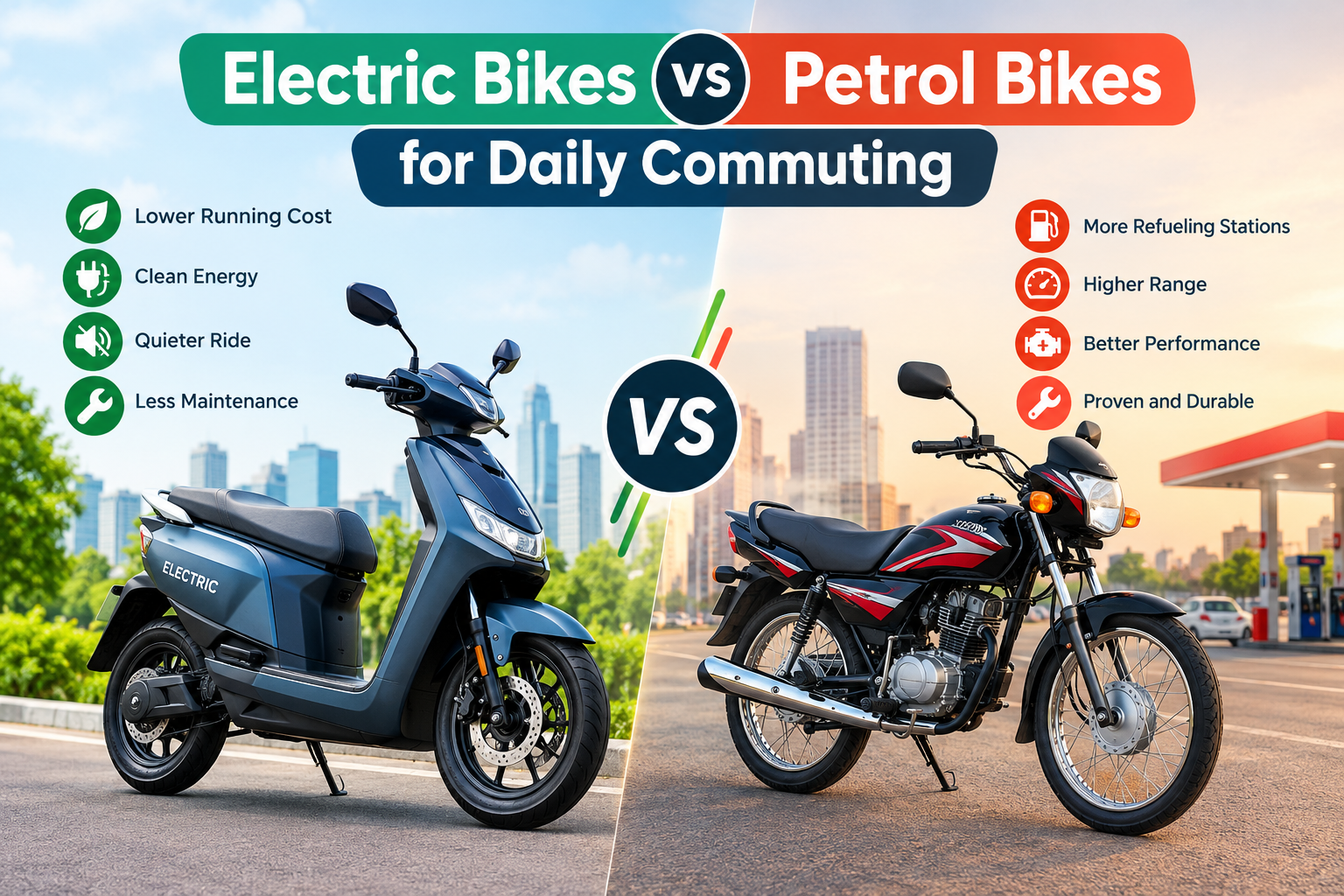
In my opinion, both types of bikes have their own advantages, and the right choice depends on how far you travel, how much you can spend, and what kind of riding experience you prefer. Electric bikes offer the benefit of lower running costs and quieter operation, while petrol bikes provide familiar performance, convenient refueling, and a well established maintenance network.
Before choosing between electric bikes and petrol bikes for daily commuting, it is important to understand their differences in cost, battery life, fuel consumption, maintenance, performance, and convenience. In this article, I will explain these factors in simple terms to help you make a practical decision.
1. Understanding Electric Bikes and Petrol Bikes
An electric bike uses an electric motor powered by a rechargeable battery. Depending on the model, the battery can be charged at home or at a compatible charging station. Instead of purchasing petrol, riders use electricity to recharge the battery.
Electric bikes are available in different designs, including electric scooters and motorcycle style models. Their range, charging time, speed, and performance depend on battery capacity, motor power, rider weight, road conditions, and the quality of the vehicle.
A petrol bike uses an internal combustion engine that burns petrol to generate power. These motorcycles are widely used for commuting because they are available in many engine sizes and are supported by established fuel stations, mechanics, and spare parts suppliers.
Both options can be suitable for everyday travel. However, the best choice depends on your daily routine and the conditions in which you ride.
2. Electric Bikes vs Petrol Bikes: Running Costs
Running cost is one of the first things I would consider when comparing electric bikes vs petrol bikes. Even a small difference in daily expenses can become significant over several months.
Electric bikes generally cost less to operate because electricity is often cheaper per kilometer than petrol. They also have fewer moving parts in their powertrain, which can reduce some routine maintenance expenses.
For example, someone who travels a short distance to work every day may find that charging an electric bike at home is convenient and affordable. However, the actual savings depend on local electricity prices, battery efficiency, charging losses, and the bike’s energy consumption.
Petrol bikes require regular fuel purchases. Their fuel expenses depend on engine size, fuel economy, petrol prices, traffic conditions, and riding habits. A fuel efficient 70cc or 100cc motorcycle may be economical for daily commuting, while a larger engine can consume more fuel.
To compare the two options fairly, calculate the cost of traveling your actual daily distance rather than relying only on advertised mileage or range.
3. Purchase Price and Initial Investment
The purchase price is another important factor when choosing between an electric bike and a petrol bike.
Electric bikes can sometimes have a higher initial price because their batteries and electrical components contribute significantly to manufacturing costs. Battery capacity, motor power, brand reputation, and warranty coverage can all affect the final price.
Petrol bikes are available across a broad range of prices. Buyers can choose an affordable commuter motorcycle or invest in a more powerful model according to their budget.
When I compare the initial cost, I would not look at the purchase price alone. I would also consider expected maintenance, charging or fuel expenses, battery replacement, resale value, and warranty coverage.
An electric bike may save money over time if it is used regularly and the battery remains in good condition. However, a higher purchase price or an expensive replacement battery can reduce those savings.
The smartest approach is to compare the total cost of ownership over several years.
4. Battery Charging vs Petrol Refueling
Convenience is one of the biggest differences between electric bikes and petrol bikes.
An electric bike can be charged at home if you have a suitable power supply and a compatible charging arrangement. This means you may be able to recharge the bike overnight and start your day with a full battery.
For people who travel predictable distances, home charging can be particularly useful. It can also reduce the need to make separate trips to purchase fuel.
However, charging takes longer than refueling a petrol motorcycle. The exact time depends on battery capacity, charger output, and the charging system. Riders also need access to reliable electricity and a safe place to charge and park the vehicle.
Petrol bikes have an advantage when it comes to quick refueling. A rider can usually fill the tank within a few minutes and continue traveling.
For people who frequently make long journeys or travel through areas with limited charging facilities, petrol bikes can be more convenient.
Before buying an electric bike, I would check whether charging at home is practical and whether the battery can cover my usual daily journey with some range left in reserve.
5. Range and Daily Travel Distance
Range determines how far a bike can travel before it needs another energy source.
Electric bike range varies considerably between models. A bike with a larger battery may travel farther than one with a smaller battery, but real world range can be lower than the manufacturer’s estimate.
Heavy loads, high speeds, frequent acceleration, steep roads, cold weather, tire pressure, and battery age can all influence how far an electric bike travels on a charge.
For daily commuting, I would choose an electric bike that comfortably covers my round trip rather than selecting one that barely meets the distance requirement.
Petrol bikes generally offer convenient long distance travel because riders can refill the tank quickly. Their total range depends on tank capacity and fuel economy.
If your daily journey is short and predictable, an electric bike may be sufficient. If you frequently travel between cities or visit places where charging options are uncertain, a petrol bike may be the more practical option.

6. Maintenance and Repair Costs
Maintenance can have a major effect on the long term cost of owning a bike.
Electric bikes usually have simpler powertrains than petrol motorcycles. They do not require engine oil changes, spark plug replacements, or conventional engine servicing. Depending on the model, this can reduce routine maintenance needs.
However, electric bikes still require attention to tires, brakes, suspension, bearings, electrical connections, and other mechanical components. Battery health also needs to be considered because battery performance can decline over time.
Repairing an electric bike may be difficult in areas where trained technicians and replacement electronic components are not readily available.
Petrol bikes require regular servicing, including engine oil changes, air filter cleaning or replacement, spark plug checks, and fuel system maintenance where applicable. Chains, sprockets, clutch components, and other parts may also need attention.
On the other hand, petrol motorcycles are familiar to many local mechanics, and spare parts may be easier to find.
In my view, maintenance costs should be evaluated according to the service network available in your area. A bike that is inexpensive to maintain on paper may become inconvenient if repairs are difficult to arrange.
7. Performance and Riding Experience
Electric bikes and petrol bikes deliver power differently.
An electric motor can provide quick acceleration from a standstill, making electric bikes suitable for stop and go traffic. Many models also operate quietly and produce little vibration, which can make daily rides feel smooth and relaxed.
Their performance depends on motor power, controller settings, battery output, vehicle weight, and the design of the bike. Not every electric model is fast or powerful, so specifications should be checked before purchasing.
Petrol bikes provide a familiar engine response and may offer more flexibility across different performance categories. Riders can choose from basic commuter motorcycles to powerful bikes designed for highways and longer journeys.
Engine sound, gear changes, clutch operation, and acceleration characteristics are also part of the riding experience.
For urban commuting, I would prioritize smooth acceleration, comfortable seating, reliable brakes, and predictable handling instead of focusing only on maximum speed.
Both types can provide a good riding experience when the bike is suitable for the rider and the road conditions.
8. Environmental Impact
Electric bikes produce no exhaust emissions while being ridden, which can help reduce roadside air pollution. Their quiet operation can also contribute to lower traffic noise.
However, an electric bike is not completely free of environmental impact. Electricity generation, battery manufacturing, mineral extraction, and battery disposal all have environmental consequences. The overall benefit depends partly on how electricity is generated and how responsibly the battery is handled at the end of its useful life.
Petrol bikes release exhaust gases during operation. The amount of pollution depends on engine design, fuel quality, maintenance, and riding conditions.
A well maintained petrol motorcycle may operate more efficiently than a poorly maintained one, but it still burns fossil fuel.
For people who want to reduce their direct contribution to urban exhaust pollution, an electric bike can be an attractive choice. Responsible battery recycling and proper maintenance make that choice more sustainable.
9. Which Bike Is Better for Pakistani Roads?
In Pakistan, the decision between electric bikes and petrol bikes depends on fuel prices, electricity costs, road conditions, local repair services, and the availability of suitable models.
Petrol motorcycles remain a familiar option for many commuters because fuel stations and motorcycle mechanics are widely available in many areas. Popular commuter bikes are also practical for people who need a straightforward transportation solution.
Electric bikes can be appealing for people who travel short distances within a city and have access to reliable home charging. They may help reduce everyday transportation expenses, particularly for riders who use their bikes regularly.
However, buyers should check battery warranty terms, replacement costs, real world range, availability of spare parts, and after sales support before purchasing an electric model.
Electricity interruptions and limited public charging facilities may also affect convenience in some locations.
I would recommend choosing a bike based on your actual travel habits and local conditions rather than buying one simply because it is newer or more popular.
10. Safety and Everyday Practicality
Safety should be a priority regardless of whether you choose an electric bike or a petrol motorcycle.
Both types need properly maintained brakes, tires, lights, mirrors, and suspension. Riders should wear an appropriate helmet, follow traffic laws, maintain a safe distance, and avoid excessive speed.
Electric bike owners should follow the manufacturer’s charging instructions, use the correct charger, and avoid charging damaged batteries. The battery should be protected from water exposure beyond the vehicle’s specified limits and from unsafe electrical connections.
Petrol bike owners should check for fuel leaks, maintain the engine and brakes, and avoid smoking or creating sparks near fuel during refueling.
Comfort also matters. Seat height, riding posture, suspension quality, carrying capacity, and the ability to handle traffic can make a substantial difference during everyday use.
A practical commuting bike should fit your body, your route, and your daily responsibilities.
11. How to Choose the Right Bike for Your Needs
Before making a final decision, I would ask myself a few simple questions.
First, how many kilometers do I travel every day? A short and predictable route may favor an electric bike, while frequent long distance journeys may favor a petrol motorcycle.
Second, can I charge an electric bike safely at home? If reliable charging is not available, a petrol bike may be easier to manage.
Third, what is my total budget? Include the purchase price, energy costs, servicing, insurance where applicable, registration, battery replacement, and resale value.
Fourth, can I obtain repairs and spare parts locally? Reliable after sales service is especially important for newer electric models.
Finally, which option suits my lifestyle? A person who commutes through crowded city streets may have different needs from someone who regularly travels between towns.
Answering these questions can help you avoid an expensive decision that does not match your daily routine.
Conclusion
Electric bikes vs petrol bikes for daily commuting is a comparison that depends on cost, convenience, distance, maintenance, and personal preferences. Electric bikes offer quiet operation, convenient home charging, and potentially lower running costs. Petrol bikes provide quick refueling, familiar servicing, and practical long distance flexibility.
In my opinion, electric bikes are worth considering for regular short distance commuting when charging is convenient and local support is reliable. Petrol bikes remain a sensible option for riders who need longer range, easy access to fuel, or a well established repair network.
There is no single winner for every rider. The best bike is the one that fits your budget, covers your daily journey comfortably, and remains reliable over time. By comparing the full ownership cost and checking the specifications carefully, you can choose a bike that makes your everyday travel easier and more affordable.