Introduction
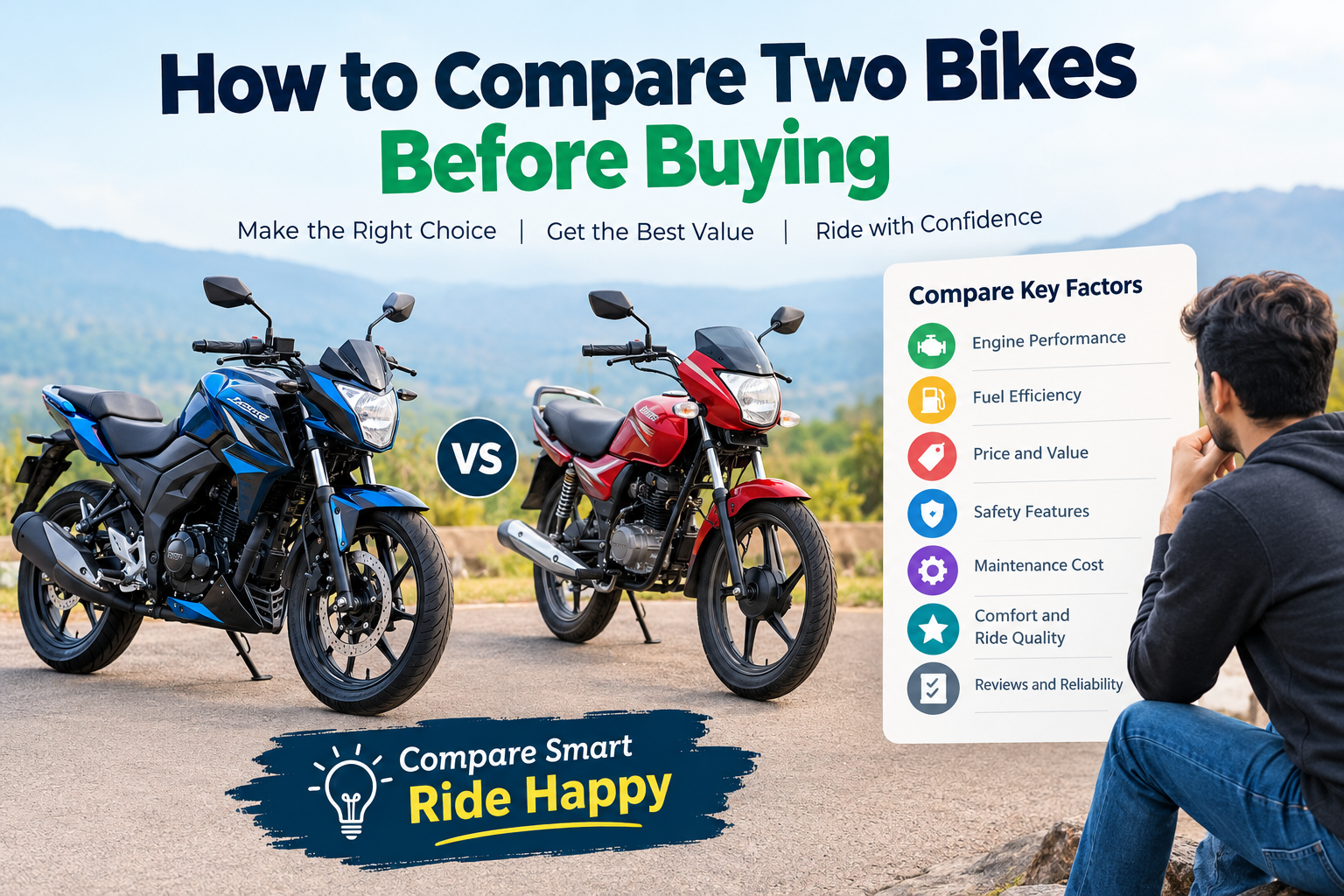
Buying a new bike is an important decision, especially when two bikes look attractive and offer similar features. One bike may have a powerful engine, while the other may provide better fuel efficiency. Similarly, one model may have a lower purchase price, but the other could be more comfortable and affordable to maintain over time. This is why learning how to compare two bikes before buying is essential for making a smart decision.
In my opinion, choosing a bike should never depend only on its appearance, brand name, or advertised features. A good bike should meet your daily needs, fit your budget, offer reliable performance, and provide a comfortable riding experience. Taking some time to compare two bikes can help you avoid unnecessary expenses and choose a model that suits your lifestyle.
In this beginner friendly guide, I will explain the most important factors to consider when comparing two bikes, including price, engine performance, fuel economy, comfort, safety, maintenance, and resale value.
1. Understand Your Riding Needs
Before comparing two bikes, think about how you plan to use them. Your riding needs should be the starting point because a bike that works well for one person may not be the right choice for another.
For example, if you need a bike for daily commuting, fuel efficiency, comfortable seating, and easy handling may be your main priorities. If you frequently travel long distances, engine performance, riding comfort, stability, and luggage capacity may be more important.
You should also consider the roads you normally travel on. A bike designed for smooth city streets may not be the best option for rough roads or long countryside journeys.
Make a short list of your requirements before visiting a dealership. This will help you focus on useful features instead of being distracted by unnecessary extras.
2. Compare the Purchase Price
Price is one of the first things most buyers consider when comparing two bikes. However, the cheapest bike is not always the best value for money.
Start by checking the official price of both models. Then consider additional expenses, such as registration, taxes, insurance, delivery charges, and any accessories you may need.
For example, suppose Bike A costs less than Bike B. Bike A might seem like the better deal at first. However, if Bike B offers better fuel economy, stronger safety features, and lower maintenance expenses, it could provide better value over several years.
I recommend setting a realistic budget before making a decision. Avoid spending your entire budget on the purchase price because you will still need money for fuel, routine servicing, protective equipment, and unexpected repairs.
Always compare the final cost rather than looking only at the advertised price.
3. Check Engine Performance
Engine performance is another important factor when comparing two motorcycles. The right engine depends on your experience, riding environment, and performance expectations.
Check the engine capacity, usually measured in cubic centimeters or cc. A larger engine may offer more power, but engine size alone does not determine how well a motorcycle performs.
You should also consider horsepower, torque, acceleration, and how smoothly the engine operates. Torque can be particularly useful when carrying a passenger, climbing hills, or riding at lower speeds.
For everyday commuting, a smaller engine may provide sufficient performance while keeping fuel expenses manageable. For frequent highway journeys, a motorcycle with stronger performance may be more suitable, depending on local road conditions and legal requirements.
If possible, take both bikes for a test ride. Pay attention to acceleration, throttle response, vibration, braking, and how easily the motorcycle moves through traffic.
Do not choose a bike simply because its engine specifications look impressive on paper. Real world comfort and usability matter just as much.
4. Compare Fuel Efficiency
Fuel efficiency can make a significant difference to your long term ownership costs, particularly if you travel every day.
Check the claimed fuel economy of both bikes and compare it using the same unit, such as kilometers per liter. Remember that manufacturer figures may differ from actual results because of traffic, road conditions, riding habits, passenger weight, and maintenance.
For a practical comparison, estimate your monthly riding distance.
For example, imagine you travel 600 kilometers every month. If one bike averages 40 kilometers per liter and another averages 50 kilometers per liter, the second bike would use approximately 12 liters of fuel instead of 15 liters.
You can calculate the expected savings using your local fuel price.
This simple calculation helps you understand whether a more expensive bike could save money over time. However, fuel economy should not be your only deciding factor. Reliability, comfort, safety, and overall ownership costs are also important.
5. Examine Comfort and Riding Position
A bike may look attractive in photographs but feel uncomfortable when you actually sit on it. This is why I consider comfort one of the most important factors when comparing two bikes.
Start by checking the seat height. You should be able to manage the motorcycle confidently when stopping and placing your feet on the ground. The ideal fit depends on your height, leg length, and experience.
Next, examine the handlebar position, footpeg placement, seat cushioning, and distance between the seat and handlebars.
An upright riding position is often comfortable for commuting, while some sporty motorcycles require a more forward leaning position. Neither design is automatically better because the right choice depends on your body and riding style.
If you regularly carry a passenger, check the passenger seat and footrests as well.
During a test ride, notice whether your wrists, shoulders, back, or knees feel strained. A comfortable bike can make daily journeys more enjoyable and reduce fatigue on longer trips.
6. Compare Safety Features
Safety should always be a major consideration when buying a motorcycle. Never overlook important safety features simply to save a small amount of money.
Compare the braking systems of both bikes. Depending on the model and market, one may offer disc brakes, drum brakes, or a combination of both. Also check whether the motorcycle includes an anti lock braking system, commonly known as ABS.
ABS helps prevent the wheels from locking during hard braking, which can help riders maintain control in many situations. Its availability and configuration vary by model.
Examine the tires, lighting, mirrors, suspension, and overall stability. Make sure the lights are visible, the mirrors provide a useful view, and the controls are easy to reach.
Check the official specifications rather than assuming that two motorcycles from the same brand have identical safety equipment.
You should also include a certified helmet and suitable protective clothing in your budget. Safe riding habits, proper training, and regular maintenance are essential regardless of which bike you purchase.
7. Compare Maintenance and Reliability
Maintenance costs can have a major effect on your total spending. Before buying either bike, find out how much routine servicing is likely to cost.
Compare the recommended service intervals, engine oil requirements, filter replacement schedules, chain maintenance needs, and other routine tasks.
You should also investigate the availability and prices of spare parts. A motorcycle may have an attractive purchase price, but finding replacement parts could be difficult if the model is uncommon in your area.
Research the reliability reputation of both models. Look for consistent feedback about engine performance, electrical problems, starting issues, and common repairs.
Owner reviews can be helpful, but do not rely on a single negative or positive comment. Look for repeated patterns across several credible sources.
It is also wise to check the warranty terms and the availability of authorized service centers.
In my view, a dependable bike with accessible spare parts is often a better long term choice than a more complicated model that costs considerably more to maintain.
8. Evaluate Design, Features, and Build Quality
Appearance is a personal preference, and it is perfectly reasonable to want a bike that matches your style. However, design should be considered alongside practicality.
Compare the quality of the paint, visible materials, switches, controls, seat finish, and overall assembly. Check for loose parts, unusual noises, uneven body panels, or signs of poor repair, especially when considering a used motorcycle.
Look at the features included with each model. Depending on the bike, these may include a digital instrument cluster, USB charging port, LED lighting, luggage racks, or other useful equipment.
Ask yourself whether you will genuinely use these features. Paying extra for technology that does not improve your everyday riding experience may not be worthwhile.
A simpler bike with good build quality can be a better purchase than a feature packed model that does not meet your practical needs.
9. Consider Resale Value
Resale value matters because you may eventually want to upgrade or sell your motorcycle.
Some models retain their value better because of their reputation, demand, parts availability, fuel economy, and maintenance costs. However, resale prices vary according to location, condition, mileage, and market demand.
Research the prices of similar used models in your area. Compare motorcycles of similar age, condition, and mileage to get a realistic idea of their value.
Also consider how easily you can find buyers for each model. A popular motorcycle may be easier to sell than an uncommon one.
Do not assume that the most expensive bike will necessarily have the highest resale value. Use actual local market information whenever possible.
10. Take Both Bikes for a Test Ride
A test ride is one of the most useful steps in comparing two bikes before buying. Specifications can explain many things, but they cannot fully describe how a motorcycle feels on the road.
If the dealership permits test rides, ride both motorcycles under similar conditions. Follow the dealer’s requirements and all local safety rules.
Pay attention to the following points:
- How easily you can start and control the bike.
- Whether the riding position feels natural.
- How smoothly the engine responds.
- Whether the clutch and gears operate comfortably.
- How confidently the brakes respond.
- Whether the suspension handles ordinary road surfaces well.
- Whether you feel comfortable stopping, turning, and maneuvering.
Do not rush the process. If one bike feels more natural and manageable, that can be a strong reason to prefer it.
For used bikes, arrange a proper mechanical inspection before completing the purchase. A test ride alone cannot reveal every possible problem.

11. Create a Simple Comparison Checklist
When two bikes have similar specifications, writing down the differences makes the decision easier. Instead of relying on memory, create a comparison table.
| Factor | Bike A | Bike B |
|---|---|---|
| Purchase price | Check price | Check price |
| Fuel efficiency | Compare real world figures | Compare real world figures |
| Engine performance | Review specifications | Review specifications |
| Riding comfort | Test ride | Test ride |
| Safety features | Verify equipment | Verify equipment |
| Maintenance cost | Check service prices | Check service prices |
| Spare parts | Check availability | Check availability |
| Warranty | Read conditions | Read conditions |
| Resale value | Research local prices | Research local prices |
You can give each factor a score from one to five according to your priorities. For example, if you travel long distances daily, comfort and fuel efficiency might receive more weight than styling.
This method makes it easier to identify which motorcycle offers the best combination of features for your situation.
12. Avoid Common Buying Mistakes
Many buyers make decisions based on excitement rather than careful research. One common mistake is choosing a bike only because it looks powerful or has an attractive design.
Another mistake is ignoring the total cost of ownership. Remember that the purchase price is only one part of your spending.
You should also avoid trusting every online review, accepting unsupported performance claims, or buying a used motorcycle without checking its documents and mechanical condition.
Never feel pressured to purchase a bike immediately because a salesperson claims that an offer will disappear soon. Take time to compare specifications, inspect the motorcycle, and read the warranty conditions.
If you are a beginner, choose a motorcycle that you can handle confidently instead of buying a model that exceeds your current experience.
A careful decision today can help you avoid regret later.
Conclusion
Learning how to compare two bikes before buying can help you make a more confident and practical purchase. The best motorcycle is not necessarily the cheapest, fastest, or most attractive model. It is the one that fits your budget, riding needs, comfort preferences, and long term ownership plans.
Before making your final decision, compare the purchase price, engine performance, fuel economy, safety features, maintenance costs, reliability, and resale value. Take both bikes for a test ride when possible, and use a comparison checklist to evaluate their strengths and weaknesses.
My recommendation is to focus on the features that matter most in your daily life. A reliable, comfortable, and economical motorcycle can provide excellent value for years when it is properly maintained.
Take your time, ask questions, verify the specifications, and avoid making a rushed decision. By following these simple steps, you can choose the right bike for your needs and enjoy a better riding experience.
Frequently Asked Questions
1. What is the most important factor when comparing two bikes?
The most important factor depends on your needs. For daily commuting, fuel economy, comfort, reliability, and maintenance costs are often priorities. For long distance riding, comfort, stability, and engine performance may be more important.
2. How can I compare two bikes easily?
Create a comparison checklist covering price, fuel economy, engine specifications, comfort, safety, maintenance, warranty, and resale value. Evaluate both models using the same criteria.
3. Should I choose a bike with a bigger engine?
Not necessarily. A bigger engine may provide more power, but it can also increase purchase and running costs. Choose an engine that matches your experience, intended use, and budget.
4. Is a test ride necessary before buying a bike?
A test ride is highly recommended when available. It helps you evaluate comfort, handling, braking, and engine response. For a used motorcycle, combine the test ride with a professional mechanical inspection.
5. How do I know which bike offers better value for money?
Compare the total cost of ownership, including the purchase price, fuel, servicing, repairs, insurance, and expected resale value. The bike with the lowest overall cost and the best fit for your needs may offer the strongest value.