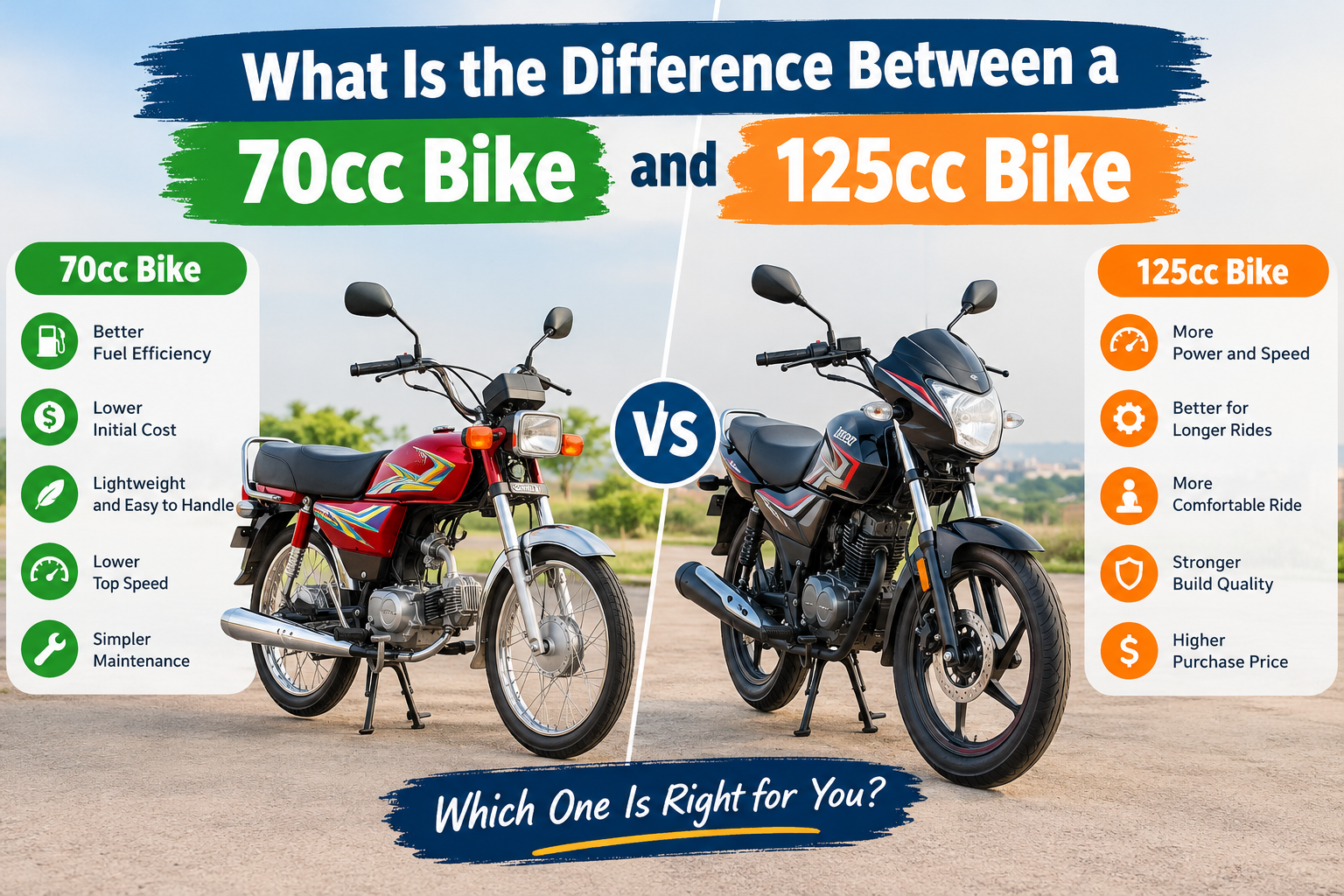
Choosing between a 70cc and 125cc bike is a common question for motorcycle buyers in Pakistan. Both motorcycles are popular for daily transportation, but they serve different needs. A 70cc bike is generally known for its fuel efficiency, affordable running costs, and lightweight design, while a 125cc bike offers more engine power, stronger acceleration, and greater flexibility for longer journeys.
In my opinion, the right choice depends on how you plan to use your motorcycle. If you mainly travel to work, college, the market, or nearby places, a 70cc bike may be enough. However, if you frequently travel with a passenger, ride on longer roads, or want more power when climbing hills, a 125cc bike may be a better option.
Before buying either motorcycle, it is important to understand the differences in engine capacity, fuel consumption, performance, comfort, maintenance, and overall cost. This guide explains these factors in simple language so you can make a practical decision.
1. Understanding the Difference Between 70cc and 125cc Bikes
The most important difference is engine capacity. The term cc stands for cubic centimeters and describes the volume displaced by the engine’s piston or pistons.
A 70cc motorcycle has a smaller engine than a 125cc motorcycle. The 125cc engine has approximately 79 percent more displacement than a 70cc engine, although this does not mean it produces exactly 79 percent more power or uses 79 percent more fuel.
Engine design, tuning, weight, transmission, and riding conditions all influence performance.
A typical 70cc motorcycle is designed for economical everyday transportation. A typical 125cc motorcycle is designed to deliver stronger acceleration and more pulling power.
Neither option is automatically best for every rider. The better motorcycle is the one that meets your transportation needs without putting unnecessary pressure on your budget.
2. Fuel Average and Petrol Consumption
Fuel consumption is one of the first things people consider when comparing a 70cc and 125cc bike. Petrol prices can make a significant difference to a household budget, especially for people who ride every day.
A 70cc bike generally consumes less petrol than a comparable 125cc bike. Its smaller engine usually requires less fuel for routine commuting, particularly when carrying a single rider at moderate speeds.
A 125cc bike usually consumes more petrol because its larger engine can produce more power. However, actual fuel economy depends on the motorcycle model, engine condition, maintenance, tyre pressure, traffic, and riding style.
For example, a rider who travels short distances through crowded city streets may get a different fuel average from someone riding on open roads. Frequent acceleration, unnecessary idling, and aggressive riding can also increase petrol consumption.
My suggestion is to check the real world fuel average of the exact motorcycle model you intend to buy rather than relying entirely on advertised figures. Ask local owners about their daily experience and calculate your expected monthly fuel expense before making a decision.
3. Engine Power and Speed
The difference in engine power becomes noticeable when you accelerate, carry extra weight, or ride on roads that require more pulling power.
A 70cc bike is suitable for ordinary city travel at moderate speeds. It can handle everyday journeys, provided it is maintained properly and used within its capabilities. However, acceleration may feel limited when carrying a passenger or travelling uphill.
A 125cc bike generally provides stronger acceleration and more pulling power. This can make overtaking easier when conditions are safe and the road allows it. It can also be useful when travelling with a passenger or carrying a reasonable load within the manufacturer’s limits.
Top speed varies between models, so it is not accurate to assign one universal speed to every 70cc or 125cc motorcycle. Engine condition, rider weight, road surface, wind, and maintenance all affect performance.
In my opinion, choosing a bike only because it can travel faster is not a wise decision. Safe handling, reliable brakes, proper protective equipment, and responsible riding are more important than maximum speed.
4. Purchase Price and Overall Budget
The purchase price is another major difference between 70cc and 125cc motorcycles in Pakistan.
Generally, a 70cc bike costs less to purchase than a comparable 125cc model. This makes it attractive to students, first time riders, delivery workers, and families who need an affordable method of transportation.
A 125cc motorcycle usually costs more because of its engine capacity, performance, and model specifications. Some models may also include upgraded components or additional features that affect the price.
However, the initial purchase price is only one part of the total cost. You should also consider registration, applicable taxes, insurance where available, fuel, routine servicing, replacement parts, and the cost of protective riding equipment.
When buying a motorcycle, I recommend setting a complete budget rather than spending all your available money on the bike itself. Keeping some money aside for maintenance and unexpected repairs can make ownership easier.
Used motorcycles also deserve careful inspection. A well maintained used 125cc bike may be a reasonable purchase, but a neglected motorcycle can require expensive repairs regardless of its engine size.
5. Maintenance and Repair Costs
Maintenance plays an important role in the long term ownership experience. Both 70cc and 125cc motorcycles need regular oil changes, chain adjustments, brake inspections, tyre checks, and general servicing.
A 70cc motorcycle often has relatively affordable routine maintenance. Its common design and widespread availability in Pakistan can make basic servicing and replacement parts easier to find, depending on the brand and location.
A 125cc motorcycle may have higher maintenance expenses, particularly if its parts cost more or it requires more expensive repairs. Nevertheless, costs vary significantly by manufacturer, model, parts quality, and the way the motorcycle has been maintained.
It is also important to remember that low maintenance costs do not mean maintenance can be ignored. Delaying oil changes, riding with worn tyres, or neglecting the brakes can shorten the motorcycle’s life and compromise safety.
Before buying, ask a mechanic about common problems with the exact model. Check the availability and prices of essential parts such as brake shoes or pads, clutch components, tyres, chains, and sprockets.
6. Comfort for Daily Riding
Comfort is not determined by engine capacity alone. Seat design, suspension, handlebar position, footpeg placement, tyre size, and motorcycle weight all affect the riding experience.
A typical 70cc motorcycle is lightweight and relatively easy to handle. This can be helpful when navigating crowded streets, making tight turns, or parking in a small space. Riders who are new to motorcycles may also appreciate its manageable size.
A typical 125cc motorcycle may offer a more substantial riding feel and can be more comfortable for certain riders on longer journeys. However, this depends on the particular model. Some 125cc motorcycles have firm suspension or seating positions that may not suit everyone.
If you travel daily, test the seating position before buying. Make sure you can reach the controls comfortably and support the motorcycle confidently when stopping.
For people who regularly carry a passenger, it is worth checking the seat length, passenger footrests, suspension condition, and the manufacturer’s recommended load capacity. A larger engine can provide additional pulling power, but it does not automatically guarantee a more comfortable ride.
7. Weight, Handling, and Control
Weight can make a noticeable difference when riding in traffic or moving a motorcycle by hand.
Many 70cc motorcycles are relatively light, making them easier to manoeuvre at low speeds. They may be convenient for narrow streets, busy markets, and tight parking areas.
Many 125cc motorcycles are somewhat heavier, although the exact weight varies by model. Some riders appreciate the more substantial feel, while others prefer a lighter motorcycle for everyday city use.
Handling also depends on wheelbase, tyre condition, suspension, steering geometry, and brake performance. A well maintained 125cc bike can handle confidently, while a poorly maintained 70cc bike may feel unstable.
For beginners, I recommend choosing a motorcycle that feels manageable rather than assuming that the smallest engine is always the easiest to ride. Practise starting, stopping, turning, and braking in a safe area before entering busy traffic.
8. Which Bike Is Better for Long Distance Travel?
If your regular routine includes longer journeys between towns or frequent travel on major roads, a 125cc motorcycle may be the more suitable option.
Its additional power can make it easier to maintain an appropriate cruising speed and respond to changes in traffic. It may also provide more flexibility when climbing hills or travelling with a passenger.
A 70cc bike can still be used for longer journeys when it is mechanically sound and the route, weather, load, and road conditions are suitable. However, it generally has less power available for acceleration and hills, so the rider may need to plan trips more carefully.
For long rides, the motorcycle’s condition matters just as much as its engine size. Inspect the tyres, brakes, lights, chain, engine oil, and other components before leaving.
Always follow local traffic laws and posted speed limits. Avoid overloading the motorcycle, and take breaks when needed. If the route includes fast moving traffic, consider whether a small commuter motorcycle provides adequate performance and protection for those conditions.

9. Resale Value and Availability of Parts
Resale value matters because many motorcycle owners eventually sell their bikes to upgrade or recover part of their original investment.
Both 70cc and 125cc motorcycles have active markets in Pakistan, but resale value depends on the brand, model, age, mileage, condition, service history, and local demand.
Popular commuter models may be easier to sell because buyers are already familiar with them. However, popularity alone does not guarantee a high resale price.
Before purchasing, compare prices for similar used motorcycles in your area. Check whether the bike has original documents, valid registration where required, and a verifiable ownership history.
Parts availability is equally important. A motorcycle with accessible replacement parts and experienced mechanics can be easier to maintain over several years.
I would rather choose a well maintained motorcycle with reliable parts support than purchase a particular model based only on appearance or engine capacity.
10. Which Bike Is Better for Students and Office Workers?
For students and office workers, the best motorcycle depends on distance, budget, and daily travel conditions.
A 70cc bike can be a practical choice for students who travel to school, college, or university and want to keep transportation expenses low. Its lightweight design and generally economical fuel consumption can make everyday commuting more affordable.
Office workers who travel short distances through congested city streets may also find a 70cc motorcycle sufficient. It can be a sensible option when the main goal is reaching work without spending too much on fuel.
On the other hand, a 125cc motorcycle may suit people whose workplaces are farther away or whose daily routes include hills, longer stretches of road, or regular passenger travel.
Delivery workers should consider their typical route, the weight they carry, daily mileage, and maintenance expenses before deciding. A more powerful engine may be useful for certain working conditions, but the additional fuel and purchase costs should fit the expected income.
The important thing is to match your motorcycle to your actual routine rather than buying a larger bike simply because it is more powerful.
11. Quick Comparison Between 70cc and 125cc Bikes
| Feature | 70cc Bike | 125cc Bike |
|---|---|---|
| Engine capacity | Smaller | Larger |
| Fuel consumption | Generally lower | Generally higher |
| Purchase price | Usually more affordable | Usually more expensive |
| Acceleration | More modest | Generally stronger |
| Pulling power | Suitable for lighter everyday use | Better for heavier loads within limits |
| Handling | Often lighter and easier to manoeuvre | Varies, often somewhat heavier |
| Maintenance | Often economical | Can cost more, depending on model |
| City commuting | Excellent for many short trips | Suitable for city and longer trips |
| Long journeys | Possible with suitable planning | Often more convenient |
| Best suited for | Budget conscious commuters | Riders needing extra power |
These are general comparisons, not guarantees for every motorcycle. Always check the specifications and ownership costs of the individual model.
12. How to Choose the Right Bike for Your Needs
Before making your final decision, ask yourself a few practical questions.
First, consider your monthly budget. If keeping fuel and routine transportation expenses low is your priority, a 70cc motorcycle may be the better fit.
Second, think about your daily distance. Short urban journeys may not require the additional power of a 125cc bike. Longer routes may make the larger engine more useful.
Third, consider how often you carry a passenger. If this happens regularly, compare the performance, seating, suspension, and load capacity of the models you are considering.
Fourth, think about your riding experience. Choose a motorcycle that you can control comfortably and confidently. If you are a beginner, practise in a safe location and learn proper braking and turning techniques before riding in heavy traffic.
Finally, check the actual ownership costs. Compare the purchase price, fuel economy reported by local owners, servicing expenses, spare parts, and expected resale value.
In my opinion, these practical factors matter much more than choosing a motorcycle based on engine capacity alone.
Conclusion
The difference between a 70cc and 125cc bike comes down to affordability, fuel consumption, engine performance, comfort, and the type of journey you regularly make.
A 70cc motorcycle is generally the better option for people who prioritise economical commuting, lower purchase costs, and easy handling. It can be ideal for students, short distance travellers, and people who mainly ride through busy city streets.
A 125cc motorcycle is generally better for riders who need stronger acceleration, additional pulling power, and greater flexibility for longer journeys. Its higher purchase price and potentially greater running costs should be considered before buying.
If I were choosing between these two types of motorcycles, I would first calculate my monthly expenses and consider my regular travel distance. I would choose a 70cc bike if affordability were my main priority, but I would consider a 125cc bike if I regularly travelled longer distances and needed extra power.
There is no single answer that works for everyone. The right motorcycle is the one that meets your daily needs, fits your budget, and allows you to travel safely and comfortably.