Introduction
A motorcycle clutch is one of the most important parts of a motorcycle because it helps the rider control how power moves from the engine to the rear wheel. Whether someone is learning to ride for the first time or has been riding for years, understanding how a motorcycle clutch works can make riding smoother, safer, and more enjoyable.
In my view, learning about the clutch is especially useful for beginners because many common riding problems happen when the clutch is not used correctly. A motorcycle may jerk when moving from a stop, stall when the clutch is released too quickly, or feel difficult to control during gear changes. Understanding the basic working principle of the clutch helps explain why these things happen and how to avoid them.
The good news is that a motorcycle clutch is not as complicated as it might seem. Once you understand its main parts and how they work together, the entire process becomes much easier to follow.
In this guide, I will explain how a motorcycle clutch works, its main components, how to use it properly, common clutch problems, and simple maintenance tips that can help keep your motorcycle running smoothly.
What Is a Motorcycle Clutch?
A motorcycle clutch is a mechanical device that connects and disconnects the engine from the transmission. The engine produces power, but the transmission needs to manage that power according to the selected gear and riding conditions. The clutch allows the rider to control this connection.
When the clutch is engaged, engine power passes through the transmission and eventually reaches the rear wheel. When the clutch is disengaged, the connection between the engine and transmission is interrupted or greatly reduced, allowing the rider to change gears or stop without necessarily switching off the engine.
For example, imagine starting a motorcycle at a traffic signal. The engine is running, but the motorcycle is not moving. If the engine remained fully connected to the transmission while the motorcycle was stationary in first gear, the engine would normally stall. The clutch allows the rider to separate the engine from the transmission while waiting and reconnect them gradually when it is time to move.
This is why the clutch is essential for smooth starts, controlled acceleration, and gear changes on most manual transmission motorcycles.
How Does a Motorcycle Clutch Work?

To understand how a motorcycle clutch works, it helps to follow the movement of power from the engine toward the rear wheel.
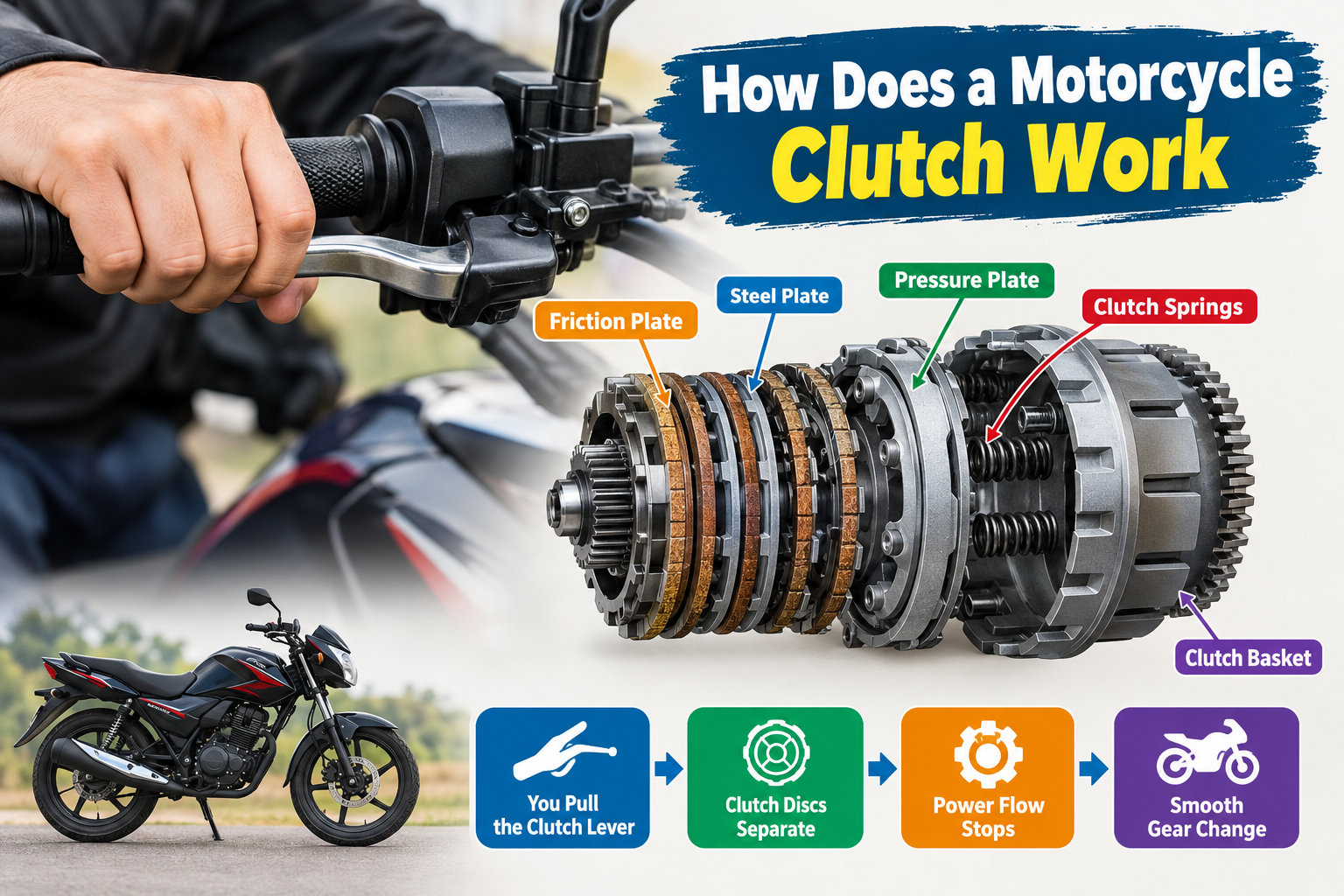
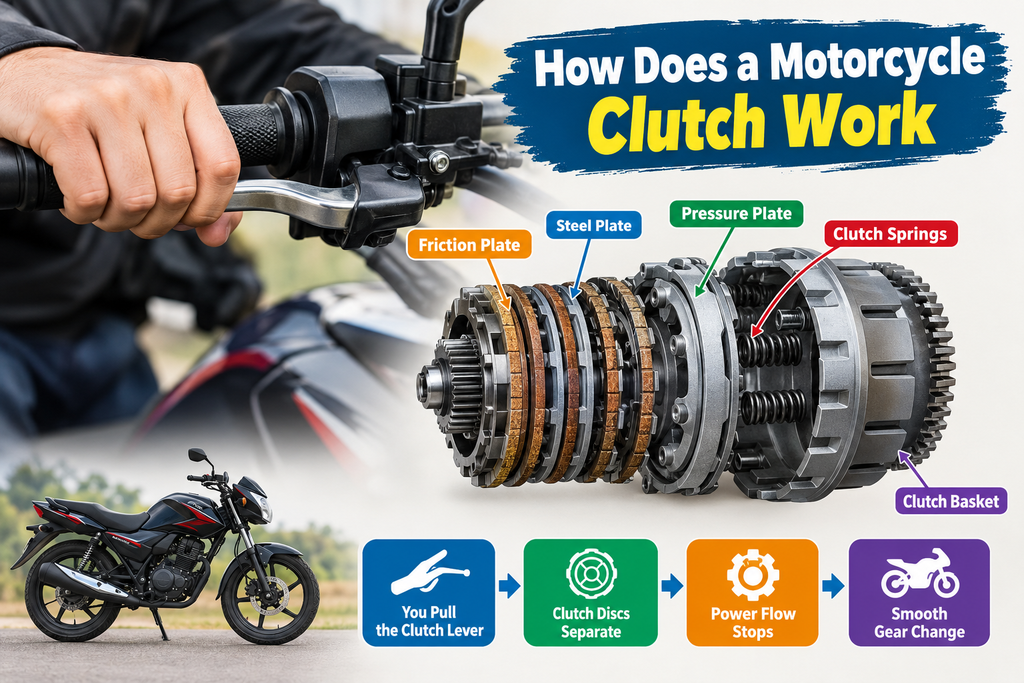
Most conventional manual motorcycles use a multi plate clutch. This design contains several friction plates and steel plates stacked together inside the clutch assembly. Springs apply pressure to these plates, allowing them to grip each other and transfer engine power.
The process works in three basic stages.
1. When the Clutch Is Engaged
When the rider releases the clutch lever, the clutch springs push the pressure plate against the stack of clutch plates. The friction plates and steel plates press firmly against one another.
Because of this pressure, the plates rotate together and transfer engine power through the transmission. The transmission then sends power through the final drive system, usually a chain, to the rear wheel.
In simple terms, the clutch is connected, and the motorcycle can move when the transmission is in gear and the rider applies suitable throttle.
2. When the Clutch Is Disengaged
When the rider pulls the clutch lever toward the handlebar, a cable or hydraulic mechanism operates the clutch release system. This moves the pressure plate against the force of the springs and reduces the clamping pressure on the clutch plates.
The plates can then slip relative to one another or separate enough to interrupt most of the power transfer, depending on the clutch design.
This allows the rider to change gears or keep the engine running while the motorcycle is stationary in gear.
3. When the Clutch Is Partially Engaged
The clutch is not simply an on or off switch. There is a middle stage in which the plates begin to grip one another but still slip.
This is commonly called the friction zone or biting point.
The friction zone is especially important when starting a motorcycle from a stop. As the rider releases the clutch lever gradually and applies appropriate throttle, the clutch transfers increasing amounts of engine power to the transmission.
Learning to control this stage is one of the most valuable skills for a beginner because it helps prevent sudden movements and engine stalling.
Main Parts of a Motorcycle Clutch
A motorcycle clutch contains several components that work together to control engine power. Knowing the purpose of each part makes it easier to understand how the entire system operates.

1. Clutch Lever
The clutch lever is located on the left handlebar of most manual motorcycles. The rider pulls it to disengage the clutch and releases it to reconnect the engine to the transmission.
The way the lever is operated affects how smoothly the motorcycle starts and changes gears. Pulling and releasing it with control is particularly important for new riders.
2. Friction Plates
Friction plates have friction material on their surfaces. They grip the neighboring steel plates when pressure is applied, allowing engine power to pass through the clutch assembly.
Over time, friction plates can wear out, especially if the clutch is used incorrectly or subjected to excessive slipping.
3. Steel Plates
Steel plates sit between the friction plates in a typical multi plate clutch. They provide the surfaces that the friction plates grip.
These plates rotate with their associated clutch components and help transfer torque through the assembly. Warped or damaged steel plates can cause clutch performance problems.
4. Pressure Plate
The pressure plate applies force to the stack of clutch plates. When the clutch lever is released, spring pressure keeps the plates clamped together.
When the lever is pulled, the release mechanism moves the pressure plate and reduces that force, allowing the clutch to disengage.
5. Clutch Springs
Clutch springs provide the pressure needed to keep the plates engaged. Their strength and condition affect how effectively the clutch transfers engine power.
Weak or damaged springs can contribute to clutch slipping, while the correct spring specification helps maintain reliable operation.
6. Clutch Basket and Hub
The clutch basket holds the outer portions of the clutch assembly, while the inner hub connects the plate stack to the transmission input side or its associated shaft.
The plates are arranged so that some rotate with the engine driven basket while others rotate with the hub. When they are clamped together, friction transfers torque between these components.
What Happens When You Change Motorcycle Gears?
Changing gears is one of the main reasons a motorcycle needs a clutch. Different gears help the engine operate effectively at different speeds and loads.
When changing gears on a conventional manual motorcycle, the rider generally rolls off the throttle, pulls in the clutch lever, selects the next gear with the gear shifter, and releases the clutch smoothly while returning to the throttle as appropriate.
The clutch briefly reduces the load connecting the engine to the transmission. This helps the transmission shift gears without the engine continuously driving the gearbox under the same load.
For example, first gear is useful when starting from a stop because it provides strong acceleration at low speeds. Higher gears are generally more suitable as the motorcycle gains speed.
Using the clutch correctly makes these changes smoother and helps reduce unnecessary stress on the drivetrain.
The exact shifting technique depends on the motorcycle and the riding conditions. Some experienced riders also use clutchless shifting on compatible motorcycles, but beginners should first learn the recommended procedure in the owner’s manual.
How to Use a Motorcycle Clutch Properly
Learning proper clutch control takes practice. I recommend starting in a safe, open area with suitable protective equipment and, ideally, guidance from a qualified instructor.
Here are some basic principles that can help.
Start with the clutch fully pulled in. Before selecting first gear, make sure the motorcycle is stable and follow the starting procedure in its manual.
Find the friction zone. Release the lever gradually until you feel the engine begin to transfer power to the rear wheel. Avoid releasing the lever suddenly.
Apply gentle throttle. Use an appropriate amount of throttle while gradually releasing the clutch. The goal is to make the motorcycle move smoothly without excessive engine revving.
Release the clutch progressively. Once the motorcycle is moving steadily, continue releasing the lever rather than keeping it partially engaged unnecessarily.
Avoid holding the clutch halfway for too long. Excessive slipping creates heat and accelerates wear, particularly when the engine is producing considerable power.
With regular practice, coordinating the clutch and throttle becomes more natural.
Common Motorcycle Clutch Problems
A motorcycle clutch can develop problems because of normal wear, incorrect adjustment, unsuitable oil, or damaged components. Recognizing the symptoms early can help prevent more expensive repairs.
Clutch Slipping
Clutch slipping occurs when the engine speed increases but the motorcycle does not accelerate as expected. Possible causes include worn friction plates, weak springs, incorrect cable adjustment, or unsuitable engine oil in motorcycles with a shared engine and clutch oil supply.
A mechanic can inspect the clutch and determine whether adjustment or replacement is necessary.
Clutch Dragging
Clutch dragging happens when the clutch does not disengage fully even though the lever is pulled. The motorcycle may creep forward while in gear, or selecting first gear may produce a noticeable clunk or make neutral difficult to find.
Possible causes include incorrect free play, a poorly adjusted hydraulic system, warped plates, or other internal problems.
Hard Clutch Lever
If the clutch lever becomes unusually difficult to pull, the problem may involve a dry or damaged cable, incorrect routing, a worn release mechanism, or an issue with the clutch assembly.
Hydraulic systems can also develop problems that affect lever operation.
Motorcycle Jerking When Moving Off
A motorcycle that jerks when starting may have a clutch control problem, but the cause is not always the clutch itself. Abrupt lever release, insufficient throttle, incorrect adjustment, or engine running problems can contribute.
Practicing gradual clutch engagement can help, but persistent jerking should be checked rather than ignored.
Tips for Motorcycle Clutch Maintenance
Proper maintenance can extend clutch life and improve riding performance.
First, check clutch lever free play according to the motorcycle manufacturer’s recommendations. Too much or too little free play can affect clutch operation.
Second, use the correct engine oil specification. Many motorcycles use a wet clutch that shares oil with the engine, so oils unsuitable for wet clutches can contribute to slipping. Follow the owner’s manual for the required specification.
Third, avoid resting your hand on the clutch lever while riding unless you need to operate it. Unnecessary lever pressure can partially disengage some clutch systems.
Fourth, avoid excessive clutch slipping when climbing hills or starting repeatedly in heavy traffic. Use the appropriate gear and avoid holding the motorcycle on a hill with the clutch alone.
Finally, have unusual noises, persistent slipping, dragging, or sudden changes in lever feel inspected by a qualified mechanic.
Frequently Asked Questions
Does a motorcycle clutch control speed?
The clutch helps control how engine power reaches the transmission, particularly when starting and changing gears. However, the throttle primarily controls engine output, while the brakes are used to slow down and stop. The clutch should not replace proper braking.
Can a motorcycle move without using the clutch?
Some motorcycles have automatic or semi automatic transmissions that operate differently from conventional manual systems. On a standard manual motorcycle, the clutch is normally used when starting from a stop and is recommended for ordinary gear changes.
How long does a motorcycle clutch last?
Clutch life varies according to the motorcycle model, riding style, maintenance, traffic conditions, and component quality. A clutch used gently may last a long time, while frequent slipping and heavy loads can shorten its life considerably.
Why does a motorcycle stall when releasing the clutch?
The engine may stall if the clutch is released too quickly, the throttle is insufficient, or the selected gear places too much load on the engine at a low speed. Gradual clutch release and appropriate throttle help prevent this.
Conclusion
Understanding how a motorcycle clutch works is an important step toward becoming a more confident rider. The clutch connects and disconnects the engine from the transmission, allowing the rider to start moving, change gears, and stop without switching off the engine every time.
Its main components, including friction plates, steel plates, springs, the pressure plate, and the clutch basket, work together to transfer engine power smoothly. Correct clutch control and regular maintenance help reduce unnecessary wear and make riding more comfortable.
In my opinion, beginners should focus on learning the friction zone, coordinating the clutch with the throttle, and avoiding unnecessary slipping. These simple habits can make a noticeable difference in everyday riding.
Once the basic working principle becomes clear, the motorcycle clutch is much easier to understand. With practice and proper maintenance, riders can develop smoother control, improve their shifting technique, and enjoy a more reliable riding experience.
WordPress Featured Image
The featured image has been created for your article, “How Does a Motorcycle Clutch Work.” It is designed as an educational automotive visual suitable for a WordPress blog.
Suggested image alt text: Motorcycle clutch mechanism showing friction plates, steel plates, pressure plate, clutch springs, and power transfer.
Suggested image caption: A motorcycle clutch controls the transfer of engine power to the transmission for smooth starts and gear changes.
SEO tip: Use the focus keyword naturally in the introduction, one relevant heading, the meta description, and the image alt text. These practices can improve clarity and SEO, although search rankings and AdSense approval are never guaranteed.
article
How Does a Motorcycle Clutch Work? A Complete Beginner’s Guide
Introduction
A motorcycle clutch is one of the most important parts of a motorcycle because it controls how power moves from the engine to the transmission. Whether you ride a 70cc commuter bike, a 125cc motorcycle, or a larger sports bike, understanding how the clutch works can help you ride more smoothly and maintain your motorcycle properly.
In my opinion, learning about the motorcycle clutch is especially important for beginners. Many new riders experience problems such as sudden jerks when starting, engine stalling, or difficulty changing gears. These problems often happen because the rider does not yet understand how the clutch and throttle work together.
The good news is that the basic working principle of a motorcycle clutch is relatively simple. It connects and disconnects the engine from the transmission, allowing the rider to start moving, change gears, and stop without turning off the engine.
In this article, I will explain how a motorcycle clutch works, its main components, the different types of motorcycle clutches, common clutch problems, and practical maintenance tips.
What Is a Motorcycle Clutch?
A motorcycle clutch is a mechanical device that connects and disconnects engine power from the transmission. The engine produces rotational force, commonly called torque, and the transmission helps deliver that power to the rear wheel at different gear ratios.
When the clutch is engaged, engine power passes through the transmission and reaches the rear wheel. When the clutch is disengaged, the power connection is interrupted or substantially reduced, allowing the rider to change gears or keep the engine running while the motorcycle is stationary.
For example, imagine waiting at a traffic signal with your motorcycle in first gear. The engine continues running, but the motorcycle is not moving because you are holding the clutch lever. When the signal changes, you can gradually release the lever and apply throttle to move forward.
Without a properly functioning clutch, controlling a manual motorcycle would be much more difficult. The clutch allows the engine and transmission to work together without requiring the engine to stop whenever the motorcycle comes to a halt.
How Does a Motorcycle Clutch Work?
Most conventional manual motorcycles use a multi plate clutch. This system contains several friction plates and steel plates arranged in a stack. Springs press these plates together to transfer power from the engine to the transmission.
The clutch works through three main stages.
1. When the Clutch Is Engaged
When the rider releases the clutch lever, the clutch springs apply pressure to the pressure plate. This presses the friction plates and steel plates together.
The plates then grip one another and rotate together, transferring engine torque through the clutch assembly and into the transmission. The transmission delivers power to the final drive, which usually consists of a chain and sprockets.
When the motorcycle is in gear and the clutch is fully engaged, the engine can drive the rear wheel. The exact relationship between engine speed and wheel speed depends on the selected gear and the motorcycle’s gearing.
2. When the Clutch Is Disengaged
When the rider pulls the clutch lever toward the handlebar, a cable or hydraulic mechanism operates the clutch release system.
This mechanism moves the pressure plate against the force of the springs, reducing the pressure on the clutch plates. The plates can then slip relative to one another or separate enough to interrupt most power transfer.
This allows the rider to change gears and stop while keeping the engine running. It also helps prevent the engine from stalling when the motorcycle is stationary in gear.
3. When the Clutch Is Partially Engaged
The clutch does not operate only in fully engaged and fully disengaged positions. There is also a middle stage where the plates begin gripping one another but still slip.
This stage is called the friction zone or biting point.
The friction zone is particularly important when starting from a stop. The rider gradually releases the clutch lever while applying suitable throttle. As the plates grip more firmly, increasing amounts of engine power reach the transmission.
Learning to control this stage is one of the most useful skills for beginners. It helps prevent sudden movements and makes starting on a motorcycle smoother.
Main Parts of a Motorcycle Clutch
Understanding the main motorcycle clutch components makes it easier to understand how the complete mechanism works.
Clutch Lever
The clutch lever is usually located on the left handlebar of a manual motorcycle. Pulling it disengages the clutch, while releasing it allows the clutch to engage again.
Smooth lever control helps the rider start moving and change gears without unnecessary jerking.
Friction Plates
Friction plates contain special friction material on their surfaces. When pressed against the steel plates, they transfer torque through friction.
These plates gradually wear down through normal use. Excessive slipping, heavy loads, and poor maintenance can accelerate wear.
Steel Plates
Steel plates are positioned between the friction plates in a typical multi plate clutch. They provide the surfaces that the friction plates grip.
Damaged or warped steel plates can affect clutch operation and may contribute to dragging or inconsistent engagement.
Pressure Plate
The pressure plate applies force to the clutch plate stack. When the lever is released, spring pressure holds the plates together.
Pulling the lever operates the release mechanism, which moves the pressure plate and reduces the clamping force.
Clutch Springs
Clutch springs provide the force needed to keep the plates engaged. If the springs become weak or damaged, the clutch may struggle to transfer engine power effectively.
Clutch Basket and Hub
The clutch basket holds the outer portions of the plate assembly, while the inner hub connects the other plates to the transmission side of the mechanism.
Some plates rotate with the basket, while others rotate with the hub. When the plates are clamped together, friction transfers torque between them.
Different Types of Motorcycle Clutches
Motorcycles use different clutch designs depending on their engine, transmission, and intended purpose.
Wet Clutch
A wet clutch operates in an oil bath, which helps cool and lubricate its components. Many motorcycles use wet multi plate clutches because this arrangement can handle substantial torque in a compact space.
Wet clutches are common on commuter motorcycles and many sports bikes. However, they generally require engine oil that meets the manufacturer’s specifications for wet clutch compatibility.
Dry Clutch
A dry clutch operates without being immersed in engine oil. Because the friction surfaces operate in a different environment, dry clutches can have distinct performance and maintenance characteristics.
They are found on certain motorcycle models, particularly some performance oriented machines. Their suitability depends on the manufacturer’s design and intended application.
Centrifugal Clutch
A centrifugal clutch engages automatically as engine speed increases. Centrifugal force moves components outward until they establish contact and begin transmitting power.
This design is commonly used in many automatic scooters and some small motorcycles. It reduces the need for the rider to operate a conventional clutch lever.
Slipper Clutch
A slipper clutch is designed to reduce excessive reverse torque transmitted from the rear wheel to the engine during aggressive downshifting.
It allows controlled slipping under certain conditions, helping reduce rear wheel hopping and improving stability. It is particularly useful on some sport and performance motorcycles.
How to Use a Motorcycle Clutch Properly
Correct clutch operation improves comfort and can help extend clutch life.
First, pull in the clutch lever before selecting first gear, following the motorcycle manufacturer’s starting procedure.
Next, apply a small and appropriate amount of throttle while gradually releasing the clutch lever. When you reach the friction zone, the motorcycle will begin to move.
Continue releasing the lever smoothly as the motorcycle gains momentum. Avoid releasing it suddenly because this can cause the engine to stall or the motorcycle to jerk.
When changing gears, ease off the throttle, pull in the clutch, select the next gear, and release the clutch progressively while returning to the throttle as appropriate.
Beginners should practise in a safe, open area with suitable protective equipment. An experienced instructor can also help develop correct clutch control.
Common Motorcycle Clutch Problems
A motorcycle clutch can develop problems because of normal wear, incorrect adjustment, unsuitable oil, or damaged components.
Clutch Slipping
Clutch slipping occurs when the engine speed rises but the motorcycle does not accelerate as expected. Worn friction plates, weak springs, incorrect adjustment, or unsuitable oil can contribute to this problem.
Clutch Dragging
Clutch dragging occurs when the clutch does not disengage completely. The motorcycle may creep forward in gear despite the lever being pulled, or selecting neutral may become difficult.
Incorrect free play, warped plates, or problems with the release mechanism may be responsible.
Hard Clutch Lever
A clutch lever that becomes difficult to pull may indicate a dry or damaged cable, incorrect cable routing, a faulty release mechanism, or an internal clutch problem.
Hydraulic clutch systems can also develop issues that affect lever operation.
Motorcycle Jerking When Starting
Jerking during takeoff can result from releasing the clutch too quickly, applying insufficient throttle, or having an adjustment problem. Engine running issues may also contribute.
Practising smooth clutch control can help, but persistent jerking should be inspected by a qualified mechanic.
Tips for Motorcycle Clutch Maintenance
Regular maintenance helps keep the clutch operating correctly.
Check clutch lever free play according to the owner’s manual. Incorrect free play can prevent the clutch from engaging or disengaging properly.
Use the recommended engine oil specification, especially if your motorcycle has a wet clutch that shares oil with the engine. Some oils are unsuitable for wet clutch systems and may contribute to slipping.
Avoid resting your hand on the clutch lever unnecessarily while riding. On some motorcycles, even slight lever pressure can affect engagement.
Do not hold the clutch in the friction zone longer than necessary. Excessive slipping generates heat and can accelerate wear.
Finally, investigate unusual noises, persistent slipping, difficult gear changes, or sudden changes in lever feel. Early inspection may prevent more extensive damage.
Frequently Asked Questions
How long does a motorcycle clutch last?
Clutch life depends on the motorcycle model, riding style, maintenance, traffic conditions, and load. A well maintained clutch used correctly may last a long time, while excessive slipping can shorten its lifespan.
Can a motorcycle run without a clutch?
Some automatic motorcycles use different systems that do not require a conventional clutch lever. On a standard manual motorcycle, the clutch is normally used when starting from a stop and is recommended for ordinary gear changes.
Why does a motorcycle stall when releasing the clutch?
The engine may stall when the clutch is released too quickly, throttle input is insufficient, or the selected gear places too much load on the engine at low speed.
Does the clutch affect motorcycle speed?
The clutch controls the transfer of engine power, but it does not directly determine the motorcycle’s maximum speed. Engine output, transmission gearing, aerodynamic resistance, and other factors influence overall performance.
Conclusion
Understanding how a motorcycle clutch works is an important part of learning motorcycle operation and maintenance. The clutch connects and disconnects the engine from the transmission, allowing riders to start smoothly, change gears, and stop without switching off the engine.
Its main components, including friction plates, steel plates, clutch springs, the pressure plate, and the clutch basket, work together to transfer engine power. Different clutch designs serve different purposes, from everyday commuting to performance riding.
In my opinion, beginners should focus on mastering the friction zone, coordinating the clutch with the throttle, and avoiding unnecessary slipping. These simple habits can improve riding comfort and help reduce premature clutch wear.
With proper use, regular maintenance, and timely repairs, a motorcycle clutch can provide reliable performance and make everyday riding smoother and more enjoyable.