Introduction
Knowing how to calculate bike average fuel consumption is important for every motorcycle owner. Whether you use your bike for daily commuting, going to college, traveling to work, or taking longer trips, understanding your fuel average can help you manage expenses and maintain your motorcycle properly. Instead of guessing how much fuel your bike consumes, you can use a simple calculation to find its actual mileage.
In my opinion, checking bike fuel average regularly is one of the easiest ways to understand a motorcycle’s performance. You do not need expensive equipment or special technical knowledge to do it. All you need is your motorcycle, a reliable fuel station, a way to track distance, and a few minutes to calculate the result.
In this guide, I will explain how to calculate bike average fuel consumption, how to use the correct formula, and which factors can affect your motorcycle mileage.
What Is Bike Average Fuel Consumption?
Bike average fuel consumption describes how efficiently a motorcycle uses fuel to cover a particular distance. In many countries, including Pakistan and India, riders commonly express this measurement as kilometers per liter, written as km/L.
For example, if your motorcycle travels 45 kilometers using one liter of petrol, its fuel average is 45 km/L.
A higher km/L figure generally means your bike travels farther on the same amount of fuel. However, actual mileage depends on the motorcycle model, engine condition, traffic, road conditions, and riding habits.
Fuel consumption can also be expressed as liters per 100 kilometers, known as L/100 km. This measurement is common in many other countries. With this method, a lower number indicates better fuel efficiency.
For everyday motorcycle owners, calculating kilometers per liter is usually the simplest way to understand fuel economy.
The Formula to Calculate Bike Average Fuel Consumption
The formula for calculating bike average fuel consumption in kilometers per liter is straightforward.
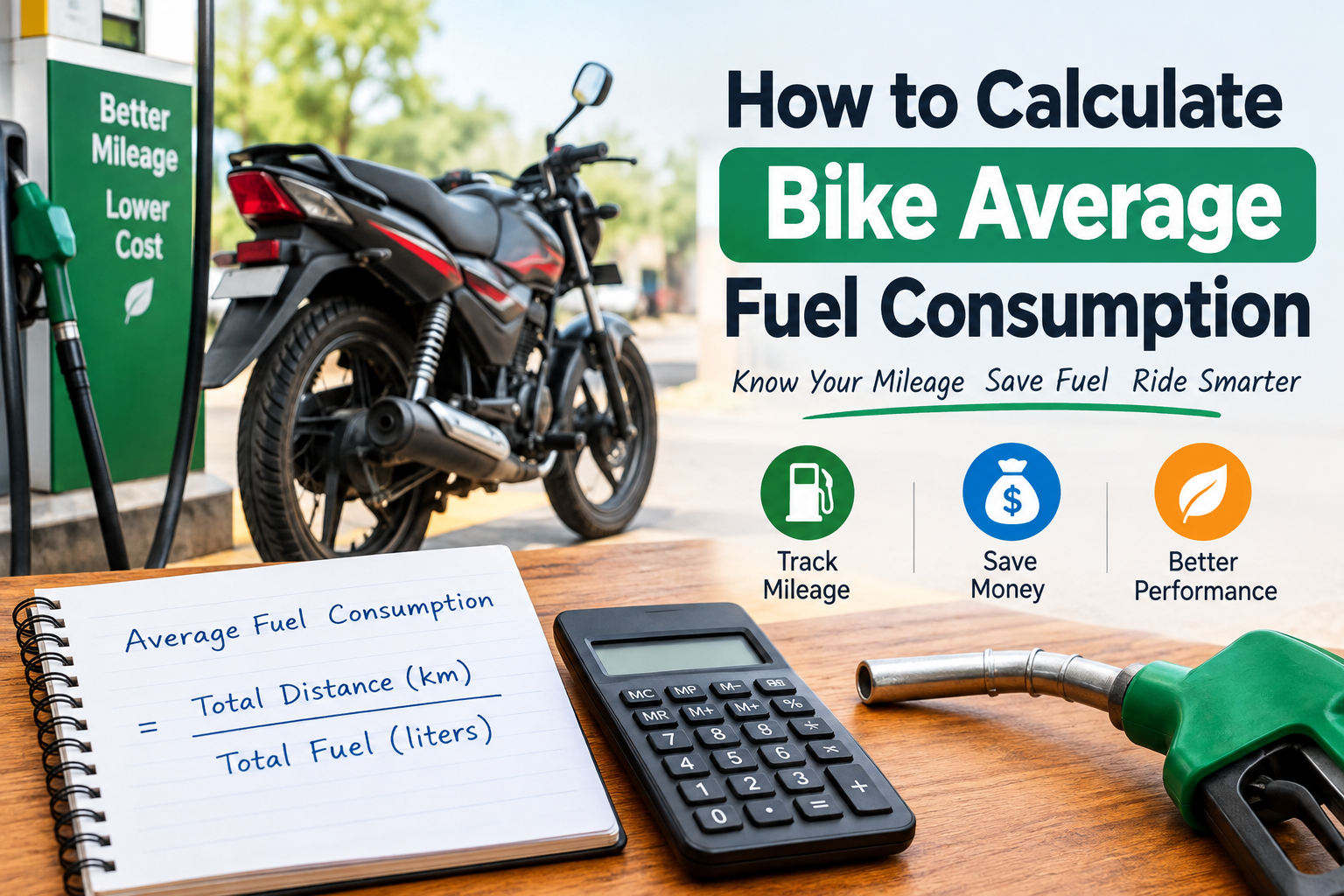
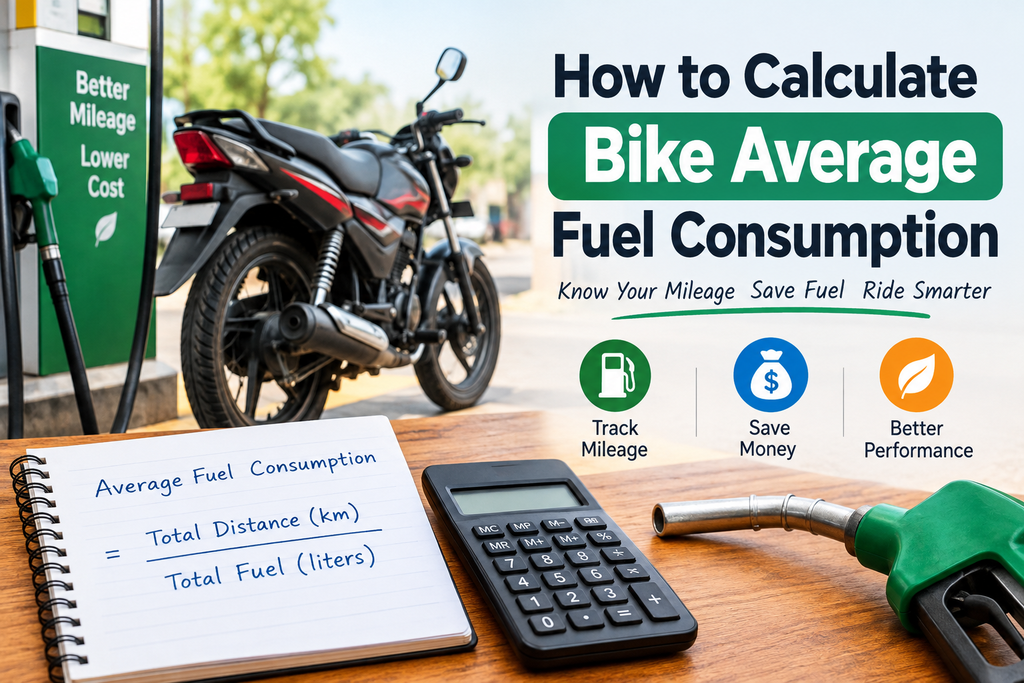
Bike Average = Total Distance Traveled ÷ Total Fuel Consumed
You need two pieces of information to use this formula:
- The total distance your motorcycle has traveled.
- The amount of petrol consumed during that distance.
For example, suppose you ride your motorcycle for 180 kilometers and use 4 liters of petrol.
The calculation will be:
180 ÷ 4 = 45 km/L
Your bike average fuel consumption is 45 kilometers per liter.
This simple formula gives you a practical estimate of your motorcycle’s real world fuel economy. The more carefully you measure distance and fuel, the more useful your result will be.
Step by Step Guide to Calculate Bike Mileage
If you want to calculate bike average fuel consumption accurately, follow these steps.
Step 1: Fill Your Fuel Tank
Start by visiting a reliable petrol station and filling your motorcycle’s tank to a consistent level. For the most practical results, use the same filling method each time.
Avoid filling beyond the manufacturer’s recommended level. Petrol needs appropriate space for expansion, so never overfill the tank.
Keep your fuel receipt or note the date and amount of fuel purchased. This information will help you track your expenses.
Step 2: Reset Your Trip Meter
If your motorcycle has a trip meter, reset it to zero after filling the tank.
A trip meter makes distance tracking easier because it records the kilometers traveled during a particular journey.
If your motorcycle does not have a trip meter, write down the current odometer reading. The odometer shows the total distance your motorcycle has traveled.
For example, if the odometer reads 12,450 kilometers, record that number before starting your ride.
Step 3: Ride Your Motorcycle Normally
Use your motorcycle for your usual activities, such as commuting to work, visiting the market, or traveling on local roads.
Try to cover a reasonable distance before checking the average. A longer test generally provides a more useful estimate because small differences in fuel filling become less significant.
For example, testing over 150 to 250 kilometers can be more informative than testing over only 10 or 15 kilometers.
Ride normally and avoid changing your usual riding style just to achieve a better result.
Step 4: Refill the Tank
After covering your chosen distance, return to the petrol station and refill the tank using the same method as before.
Record how many liters of petrol are required to bring the tank back to the original filling level.
The amount of petrol added provides an estimate of the fuel consumed during your test, provided the starting and ending fuel levels are consistent.
For example, if you traveled 200 kilometers and needed 4.5 liters to refill the tank, use 4.5 liters as the estimated fuel consumed.
Step 5: Calculate Your Bike Average
Now apply the formula.
Total distance = 200 kilometers
Fuel consumed = 4.5 liters
Bike average = 200 ÷ 4.5
Result = approximately 44.44 km/L
Your motorcycle therefore delivers an estimated average of 44.44 kilometers per liter under the conditions of your test.
This method is simple, affordable, and suitable for most motorcycle owners.
Practical Example of Bike Average Fuel Consumption
Let us consider another example to make the calculation easier to understand.
Suppose you own a 125cc motorcycle and want to check its fuel economy. You fill the tank, reset the trip meter, and ride for several days.
At the next refill, your trip meter shows 225 kilometers, and the tank requires 5 liters of petrol to return to the same level.
Using the formula:
225 ÷ 5 = 45 km/L
Your motorcycle’s estimated fuel average is 45 kilometers per liter.
You can also calculate the distance you might travel with 10 liters of petrol.
45 × 10 = 450 kilometers
This is only an estimate. Actual distance may vary because of traffic, road conditions, load, maintenance, and riding behavior.
I recommend recording these results over several refills rather than relying on a single test. Doing so helps you understand your motorcycle’s typical fuel economy more reliably.
How to Calculate Fuel Consumption in Liters per 100 Kilometers
Some riders prefer to measure fuel consumption in liters per 100 kilometers. This method shows how much petrol a motorcycle needs to cover a fixed distance.
The formula is:
Fuel Consumption = (Fuel Used ÷ Distance Traveled) × 100
Suppose your bike uses 3 liters of petrol to travel 100 kilometers.
The calculation is:
(3 ÷ 100) × 100 = 3 L/100 km
If your motorcycle travels 200 kilometers using 5 liters, the result is:
(5 ÷ 200) × 100 = 2.5 L/100 km
This means your bike consumes 2.5 liters of petrol for every 100 kilometers traveled.
Remember that km/L and L/100 km express the same basic concept differently. Higher km/L is generally better, while lower L/100 km indicates lower fuel consumption.
Factors That Affect Bike Average Fuel Consumption
Calculating your bike average is only the first step. Understanding why the result changes is equally important.
1. Riding Style
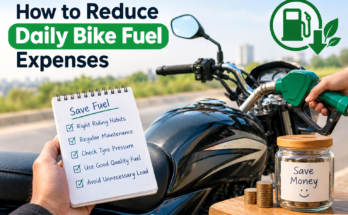
Your riding habits can significantly affect fuel consumption. Rapid acceleration, unnecessary high engine speeds, and frequent hard braking may increase petrol usage.
Smooth acceleration and maintaining a suitable speed can help improve fuel efficiency.
2. Tyre Pressure
Incorrect tyre pressure can increase rolling resistance and affect handling. Underinflated tyres may cause your motorcycle to use more fuel.
Check tyre pressure regularly and follow the pressure recommendations in your owner’s manual. Do not increase pressure beyond the recommended level in an attempt to save petrol.
3. Engine Maintenance
A poorly maintained engine may not operate as efficiently as it should. Dirty air filters, worn spark plugs, incorrect valve clearances, and other mechanical problems can affect performance and fuel economy.
Following the manufacturer’s maintenance schedule helps keep your motorcycle in good condition.
4. Traffic Conditions
Stop and go traffic often reduces fuel efficiency because the engine continues running while the motorcycle covers relatively little distance.
A motorcycle that delivers good mileage on an open road may produce a lower average in crowded city traffic.
For this reason, compare fuel averages under similar riding conditions whenever possible.
5. Extra Weight
Carrying unnecessary weight can increase the energy required to move your motorcycle. Heavy luggage and additional loads may affect fuel consumption, especially during frequent acceleration.
Carry only what you need and make sure the motorcycle remains within its specified load limit.
6. Fuel and Engine Problems
Poor running conditions, fuel system issues, dragging brakes, and other mechanical faults may reduce fuel efficiency.
If your motorcycle’s mileage suddenly drops, do not assume that your riding style is the only reason. Have a qualified mechanic inspect the bike if the problem continues.
Common Mistakes When Calculating Bike Mileage
Many riders calculate fuel average incorrectly because they overlook small details.
One common mistake is estimating fuel consumption from the amount of petrol purchased without accounting for the fuel already in the tank. The refill method works best when the starting and ending fuel levels are consistent.
Another mistake is testing over a very short distance. Small variations in filling level can produce a misleading result when only a small amount of fuel is used.
Some riders also compare city mileage with highway mileage without considering the difference in riding conditions.
Finally, do not rely entirely on a manufacturer’s advertised fuel economy. Official figures may come from standardized tests that differ from everyday riding conditions.
For a realistic result, measure your own motorcycle’s fuel consumption using consistent methods and repeat the test over several refills.
Tips to Improve Your Bike Fuel Average
Once you know your motorcycle’s actual mileage, you can take practical steps to maintain or improve it.
Keep your tyres at the recommended pressure and follow the scheduled maintenance plan. Use the engine oil grade specified by the manufacturer and replace it at the recommended intervals.
Accelerate smoothly, shift gears appropriately, and avoid unnecessary high engine speeds. Switch off the engine when you expect to remain stationary for an extended period and doing so is safe and practical.
Plan your journeys to reduce unnecessary travel, and avoid carrying items that you do not need.
Most importantly, pay attention to changes in fuel consumption. A gradual change may reflect different traffic or seasonal conditions, while a sudden and persistent drop could indicate a maintenance issue.
How Often Should You Calculate Bike Average Fuel Consumption?
For regular motorcycle users, checking fuel average every few weeks or during routine refills is a practical approach.
If you use your motorcycle daily, recording the distance traveled and petrol purchased can help you understand monthly fuel expenses.
You can maintain a simple notebook or spreadsheet with the date, odometer reading, liters purchased, petrol price, and calculated mileage.
For example, if your bike consistently delivers around 45 km/L but suddenly drops to 32 km/L under similar conditions, investigate the reason rather than immediately assuming the motorcycle needs major repairs.
Repeated measurements provide a clearer picture of normal performance than a single reading.
Conclusion
Learning how to calculate bike average fuel consumption is a simple way to understand your motorcycle’s efficiency and manage petrol expenses. You do not need special tools or technical expertise. By filling the tank consistently, tracking your distance, recording the fuel used, and dividing kilometers traveled by liters consumed, you can estimate your bike’s real world mileage.
In my view, regular mileage tracking is a useful habit for every motorcycle owner. It helps you understand your bike’s normal performance, identify unusual changes, and make better decisions about maintenance and riding habits.
Remember to test over a reasonable distance, compare similar riding conditions, and repeat the calculation over several refills. With consistent tracking and proper motorcycle care, you can better understand your fuel consumption and work toward more efficient everyday riding.
Frequently Asked Questions
1. What is the formula for calculating bike average?
Divide the total distance traveled in kilometers by the amount of petrol consumed in liters. For example, 200 kilometers divided by 4 liters equals 50 km/L.
2. How can I check my bike mileage without a trip meter?
Record the starting odometer reading, ride your motorcycle, and record the ending reading. Subtract the starting reading from the ending reading to find the distance traveled. Then divide that distance by the estimated fuel consumed.
3. How many kilometers can a bike travel on one liter of petrol?
The distance depends on the motorcycle’s engine, condition, riding style, traffic, and road conditions. Calculate your own motorcycle’s average to obtain a more useful estimate than relying on a general figure.
4. Why does my bike give different mileage every time?
Fuel average can change because of traffic, speed, weather, road conditions, fuel filling differences, tyre pressure, and maintenance. Repeating the test over several refills can help you determine your typical mileage.
5. Is higher bike mileage better?
Generally, yes. A higher km/L value means the motorcycle travels farther using the same amount of fuel. However, fuel efficiency should be considered alongside safe handling, reliable performance, and proper maintenance.