SEO Optimized Article | Beginner Friendly | Automotive Guide
SEO Title: Different Types of Motorcycle Engines Explained: A Complete Beginner’s Guide
Focus Keyword: Different types of motorcycle engines
Meta Description: Learn about different types of motorcycle engines, including single cylinder, twin cylinder, parallel twin, V twin, inline four, and more. Understand their performance, fuel efficiency, advantages, and best uses.
Suggested URL Slug: different-types-of-motorcycle-engines
Introduction
Motorcycles come in many shapes and sizes, and one of the biggest differences between them is the engine. Some motorcycles are designed for daily commuting, while others are built for long distance touring, high speed performance, or off road adventures. The type of engine a motorcycle uses has a major influence on how it rides, how much fuel it consumes, how much maintenance it needs, and how much power it produces.
In my view, understanding motorcycle engines is useful for anyone who wants to buy a new bike or learn more about motorcycle technology. Many beginners focus only on engine capacity, such as 125cc, 150cc, 250cc, or 600cc. However, engine capacity is only one part of the story. The number of cylinders, cylinder arrangement, cooling system, and engine design can also make a significant difference.
Different types of motorcycle engines offer different benefits. A small single cylinder engine can be practical and economical, while a four cylinder engine can deliver smooth power at high speeds. Twin cylinder engines often provide a useful balance between performance, comfort, and cost.
In this guide, I will explain the most common types of motorcycle engines, how they work, and what makes each one suitable for different riding needs.
1. Single Cylinder Motorcycle Engine

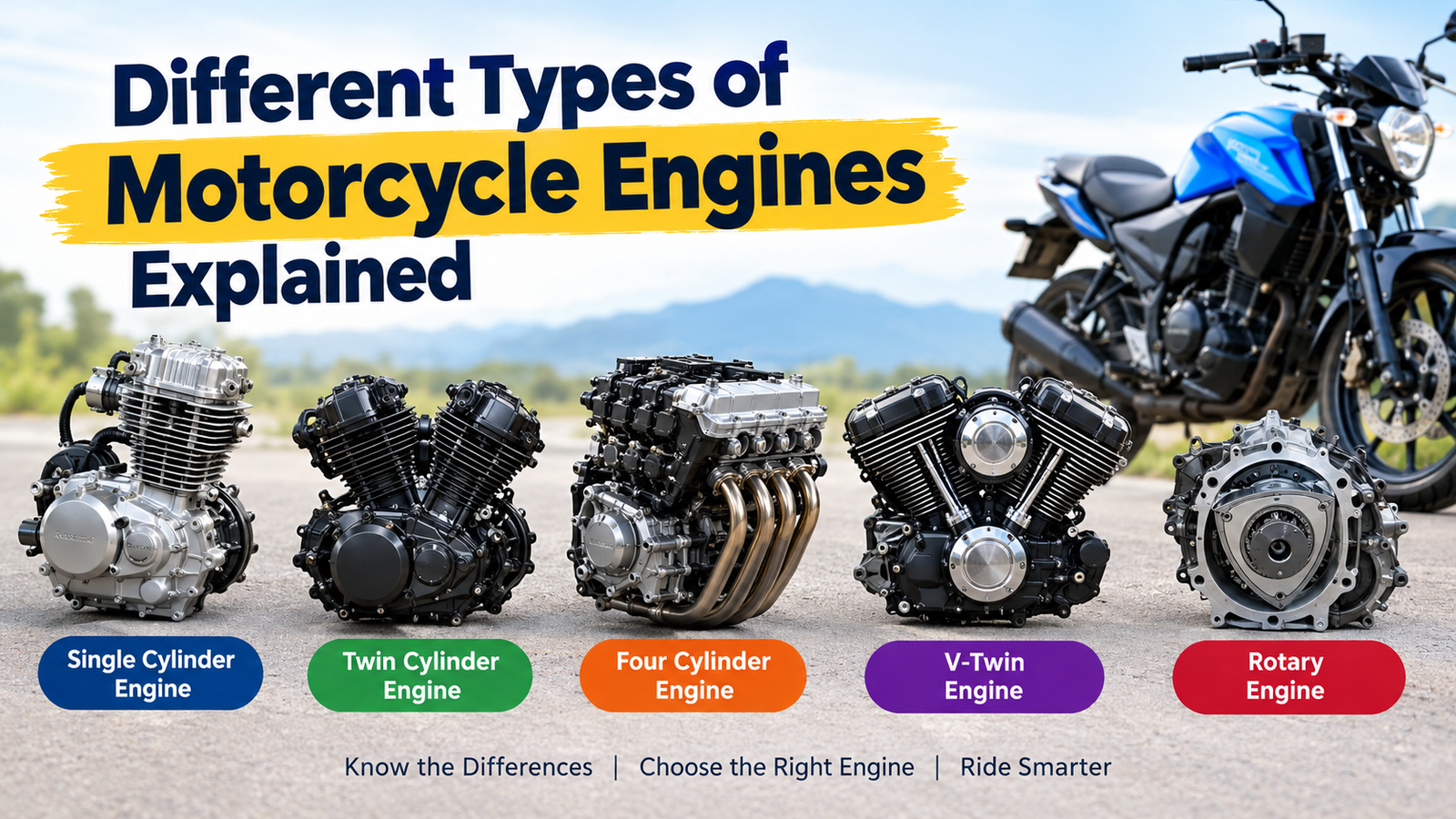
A single cylinder engine uses one cylinder to generate power. It is one of the simplest and most common motorcycle engine designs, particularly in commuter motorcycles, lightweight trail bikes, and entry level models.
Single cylinder engines are popular because their construction is relatively simple. They generally have fewer major moving components than engines with multiple cylinders, which can make them easier and less expensive to maintain.
Another advantage is fuel efficiency. Many small displacement single cylinder motorcycles are designed for everyday transportation, making them suitable for people who travel to work, school, or nearby markets.
However, single cylinder engines can produce noticeable vibration, especially at higher engine speeds. Their power delivery may also feel less smooth than that of some multi cylinder engines.
Main advantages: Affordable maintenance, simple construction, practical fuel consumption, and good low speed usability.
Best suited for: Daily commuting, beginner riders, lightweight motorcycles, and budget conscious owners.
2. Twin Cylinder Motorcycle Engine

A twin cylinder engine has two cylinders that work together to produce power. Compared with a single cylinder engine, it can offer smoother operation and greater performance potential, although the actual result depends on the engine design.
Twin cylinder engines are common in standard motorcycles, sport bikes, adventure motorcycles, and touring models. Manufacturers use different cylinder arrangements to achieve particular riding characteristics.
For example, some twin cylinder engines provide strong low and middle range torque, which is useful for overtaking and carrying a passenger. Others are designed to deliver power smoothly across a wider range of engine speeds.
Twin cylinder engines can be more complex than single cylinder designs, but they often provide a practical compromise between performance, size, cost, and comfort.
Main advantages: Balanced performance, useful torque, and a wide range of applications.
Best suited for: Everyday riding, weekend trips, highway travel, and riders who want more performance than a basic commuter bike offers.
3. Parallel Twin Engine

A parallel twin is a particular type of twin cylinder engine in which the two cylinders sit side by side in a shared engine arrangement. It is widely used because it can provide a compact design without requiring the space of some larger engine layouts.
One reason manufacturers favor parallel twin engines is their versatility. They can be tuned for comfortable everyday riding, strong acceleration, or sporty performance.
The crankshaft design and firing interval influence the way a parallel twin feels. Some versions deliver a smooth, predictable character, while others produce stronger pulses that give the motorcycle a more distinctive feel.
Parallel twin engines are often found in middleweight motorcycles, including naked bikes, adventure bikes, and sport touring models.
From a practical perspective, I consider this layout a good middle ground for riders who want a motorcycle that works well in city traffic but remains comfortable on longer journeys.
Main advantages: Compact packaging, versatile performance, and suitability for many motorcycle categories.
Best suited for: Commuters who travel on highways, touring riders, and people looking for a versatile middleweight motorcycle.
4. V Twin Motorcycle Engine

A V twin engine contains two cylinders positioned at an angle to each other, forming a V shape. This layout is especially associated with cruisers and some touring motorcycles, although it is also used in performance oriented models.
One of the most recognizable characteristics of a V twin motorcycle engine is its distinctive exhaust sound. The sound depends on the engine’s crankshaft design, firing intervals, exhaust system, and tuning, so not every V twin sounds the same.
V twin engines can produce substantial torque at relatively low engine speeds. This characteristic is useful for relaxed cruising, steady acceleration, and carrying extra weight during longer rides.
The design can also give a motorcycle a distinctive appearance. However, the space required by the cylinders and the placement of engine components can make packaging and maintenance more complicated in certain models.
Main advantages: Strong torque, distinctive engine character, and a popular design for cruising motorcycles.
Best suited for: Cruiser enthusiasts, relaxed highway riders, and people who appreciate a traditional motorcycle riding experience.
5. Inline Four Cylinder Engine

An inline four cylinder engine uses four cylinders arranged in a straight row. It is a popular choice for sport motorcycles because it can deliver smooth power and strong performance at high engine speeds.
With four cylinders sharing the workload, an inline four can provide a refined feel and a broad operating range. Many high performance examples produce their strongest acceleration when the engine is revved higher, although characteristics vary by model and tuning.
These engines are often found in sport bikes, naked performance motorcycles, and some touring motorcycles. They can be excellent for riders who enjoy responsive acceleration and smooth operation on open roads.
The main disadvantages are that inline four engines can be wider than some twin cylinder designs and may involve higher maintenance costs. Fuel consumption can also increase when the engine is ridden aggressively.
Main advantages: Smooth operation, strong high speed performance, and excellent power potential.
Best suited for: Experienced riders, sport riding, and people who prioritize performance over the lowest ownership cost.
6. Boxer or Flat Twin Engine

A boxer engine has two cylinders positioned horizontally opposite each other. Instead of pointing upward or forming a V shape, the cylinders extend outward from the sides of the motorcycle.
This arrangement can help lower the center of gravity, which may contribute to stability and a planted feeling while riding. The engine also has a distinctive appearance because its cylinders are easy to recognize.
Boxer engines are particularly associated with certain touring and adventure motorcycles. Their design can suit long distance travel because it can combine smooth operation with useful torque.
However, the cylinders extend outward, which can affect the motorcycle’s width and ground clearance in certain situations. Repairs and servicing depend on the specific model and component being maintained.
Main advantages: A low center of gravity, distinctive construction, and comfortable performance for touring.
Best suited for: Adventure touring, long distance riding, and motorcyclists who value stability and comfort.
7. Two Stroke Motorcycle Engine
A two stroke engine completes its power cycle in two piston strokes, using a different operating process from a conventional four stroke engine.
Two stroke motorcycle engines have historically been popular in lightweight motorcycles, off road bikes, and certain performance models. Their relatively simple construction can provide a high power output for their size and weight.
However, many traditional two stroke engines burn lubricating oil along with fuel, which can increase exhaust emissions. Modern emissions requirements have limited their use in many road motorcycle markets, although two stroke engines remain relevant in some specialized applications.
These engines may also require more frequent maintenance, depending on the design and riding conditions.
Main advantages: Low weight, simple mechanical construction, and strong power potential relative to engine size.
Best suited for: Certain off road applications, specialized motorcycles, and riders familiar with two stroke maintenance.
8. Four Stroke Motorcycle Engine
A four stroke engine completes its operating cycle through four stages: intake, compression, power, and exhaust. It is the standard engine type in most modern road motorcycles.
During the intake stage, the engine draws in the air and fuel mixture, or air alone in many fuel injected designs. Compression prepares the charge for combustion, the power stroke produces useful energy, and the exhaust stage removes combustion gases.
Four stroke engines are available in single cylinder, twin cylinder, three cylinder, and four cylinder configurations. This means four stroke describes how an engine operates rather than how many cylinders it contains.
They are widely used because modern designs can provide a useful balance of fuel economy, durability, performance, and emissions control.
Main advantages: Versatile design, broad availability, and suitability for everyday road use.
Best suited for: Commuting, touring, sport riding, and most general motorcycle applications.
9. Three Cylinder Motorcycle Engine

A three cylinder motorcycle engine, sometimes called an inline triple, uses three cylinders arranged in a row. It combines some characteristics of twin cylinder and four cylinder engines.
Many three cylinder engines offer strong midrange torque, smooth acceleration, and an engaging exhaust note. Depending on the design, they can feel responsive at lower engine speeds while still providing impressive performance as the revs increase.
This layout is used in several performance motorcycles, naked bikes, and sport touring models. Its main appeal is the combination of flexibility and power without necessarily requiring the size of a larger four cylinder engine.
The disadvantage is that three cylinder engines can be less common than single cylinder and twin cylinder engines in some markets, which may affect parts availability or servicing options.
Main advantages: Flexible power delivery, strong acceleration, and a distinctive engine character.
Best suited for: Riders seeking a balance of sporty performance, everyday usability, and highway comfort.
10. Rotary Motorcycle Engine

A rotary engine, also known as a Wankel engine, works differently from a conventional piston engine. Instead of moving pistons up and down inside cylinders, it uses a rotating triangular rotor inside a specially shaped housing.
Rotary engines are unusual in motorcycles because relatively few production models have used them. Their compact design and smooth operation make them technically interesting, but fuel consumption, emissions, sealing requirements, and heat management can present challenges.
For most everyday riders, a rotary engine is more of a specialist design than a practical mainstream choice. Nevertheless, it demonstrates how motorcycle manufacturers have explored different ways to produce power.
Main advantages: Compact construction, fewer reciprocating components, and smooth power delivery.
Best suited for: Enthusiasts interested in unusual engineering and specialized motorcycle designs.
How to Choose the Right Motorcycle Engine
Choosing the right motorcycle engine depends on your riding habits, budget, experience, and expectations. I recommend looking beyond engine capacity and considering how the motorcycle will actually be used.
Here are a few important factors to consider.
Daily commuting: A small single cylinder four stroke engine can be a sensible option for regular city travel because of its practical running costs and straightforward design.
Highway riding: A twin cylinder or three cylinder engine may provide a useful combination of torque, acceleration, and comfort for longer trips.
Sport performance: An inline four or a performance focused twin cylinder engine may suit riders looking for quick acceleration and responsive handling.
Long distance touring: Consider engine smoothness, riding position, vibration, fuel range, luggage capacity, and passenger comfort rather than choosing by cylinder count alone.
Maintenance budget: Check the manufacturer’s recommended service schedule, spare parts availability, and local mechanic experience before making a purchase.
It is also important to consider the motorcycle’s weight, braking system, tire quality, and safety features. A powerful engine is not automatically the best choice for every rider.
Final Thoughts
Understanding the different types of motorcycle engines makes it easier to compare motorcycles and select one that matches your needs. Single cylinder engines are often practical for everyday transportation, twin cylinder engines offer versatility, and three cylinder and four cylinder engines can deliver a more performance focused riding experience. Boxer, V twin, two stroke, and rotary designs each have their own characteristics and applications.
In my opinion, the best motorcycle engine is not necessarily the biggest or most powerful one. It is the engine that provides the right balance of performance, comfort, fuel economy, maintenance costs, and reliability for your intended use.
Before buying a motorcycle, compare a few models, review their specifications, and take a test ride if possible. Paying attention to how the engine behaves in real riding conditions can help you make a more informed decision.
Whether you need an economical commuter or a powerful touring motorcycle, understanding engine design is a useful first step toward choosing a bike you can enjoy for years.
Frequently Asked Questions
1. Which motorcycle engine is best for beginners?
A manageable single cylinder four stroke engine is often a good starting point because it can be affordable to operate and relatively simple to maintain. The appropriate engine size also depends on the rider’s experience and local licensing rules.
2. Which motorcycle engine is best for fuel efficiency?
Many small displacement single cylinder engines offer good fuel economy, but actual consumption depends on the motorcycle’s weight, engine tuning, riding speed, maintenance, and traffic conditions.
3. Is a twin cylinder engine better than a single cylinder engine?
Not in every situation. A twin cylinder engine may provide smoother operation and greater performance potential, while a single cylinder engine may be simpler, lighter, and less expensive to maintain.
4. What is the difference between a two stroke and a four stroke engine?
A two stroke engine completes its power cycle in two piston strokes, while a four stroke engine uses four. Their lubrication systems, emissions, performance characteristics, and maintenance requirements can differ significantly.
5. Does a higher cylinder count always mean more power?
No. Power depends on several factors, including engine capacity, design, tuning, airflow, and engine speed. A well designed twin cylinder engine can produce more power than a poorly matched four cylinder engine.