Introduction
A motorcycle is one of the most convenient ways to travel, whether I am going to work, visiting friends, or running daily errands. However, one of the most frustrating situations for any rider is turning the key, pressing the starter button, and discovering that the bike will not start. Sometimes the engine does not respond at all, while in other cases it cranks repeatedly but refuses to run.
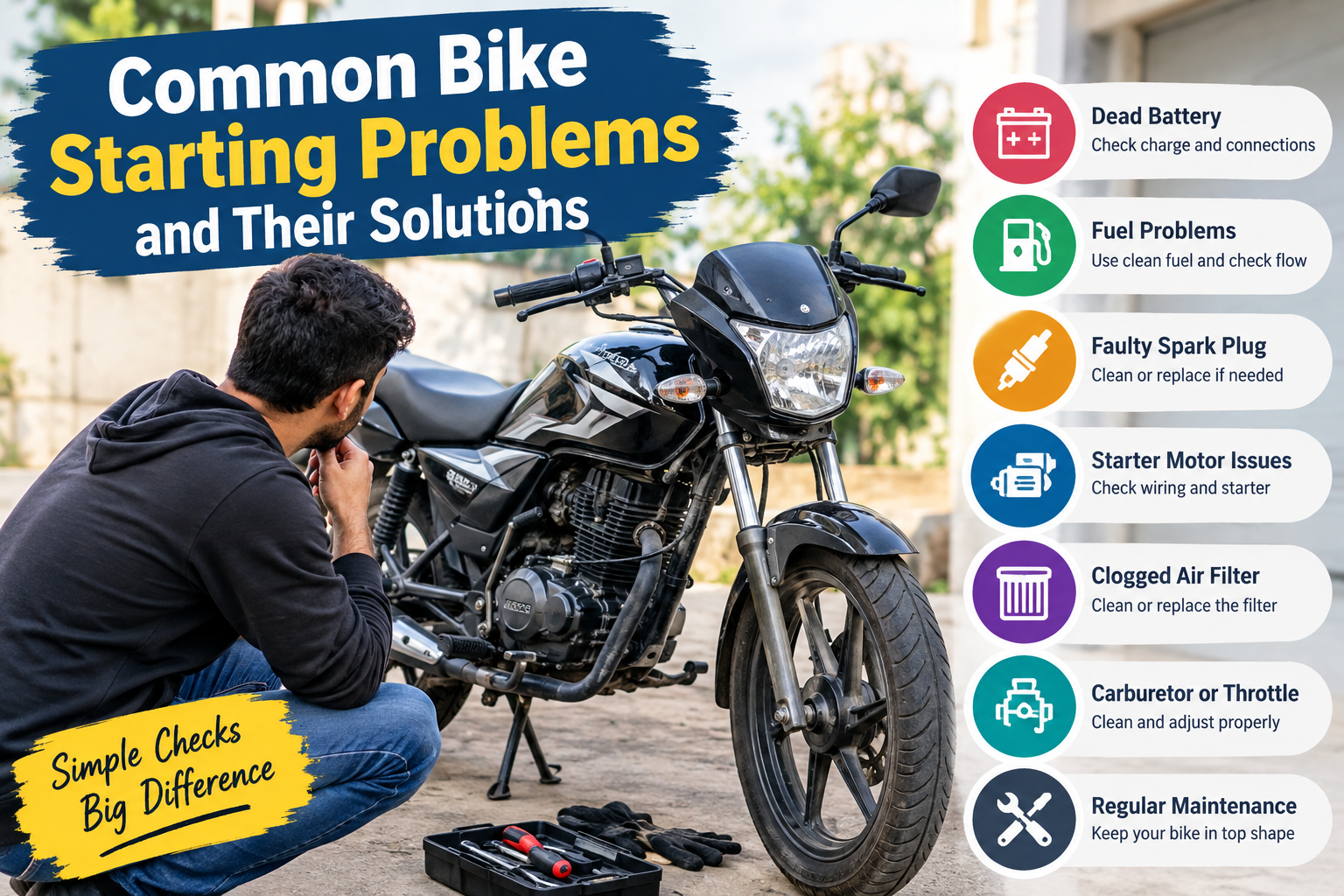
Common bike starting problems can happen because of a weak battery, insufficient fuel, a faulty spark plug, electrical issues, or poor maintenance. The good news is that many starting problems have simple causes that riders can identify through basic checks.
In my view, understanding these problems helps save time, reduce unnecessary repair costs, and keep a motorcycle in good condition. In this article, I will explain the most common bike starting problems and their solutions so that riders can better understand what to check when their motorcycle refuses to start.
1. Weak or Dead Battery
A weak or dead battery is one of the most common reasons a motorcycle fails to start. The battery supplies electrical power to the starter motor, ignition system, lights, and other electrical components.
When the battery becomes weak, the starter may turn slowly, produce clicking sounds, or fail to respond. Sometimes the dashboard lights also become dim when the starter button is pressed.
Solution
First, check whether the dashboard lights and horn work normally. Inspect the battery terminals for loose connections, corrosion, or dirt. If the terminals are dirty, clean them safely according to the manufacturer’s instructions.
A multimeter can help you check the battery voltage. For a typical fully charged 12 volt lead acid battery, the resting voltage is around 12.6 to 12.8 volts, although readings vary by battery type and condition.
If the battery is discharged, recharge it using a compatible charger. If it repeatedly loses charge, have the battery and charging system tested. Replace the battery if it can no longer hold a proper charge.
2. Empty Fuel Tank or Fuel Supply Problems
Sometimes a motorcycle does not start simply because it has insufficient fuel. Even when the fuel gauge shows some petrol remaining, the reading may not always be accurate.
Fuel supply problems can also occur when a fuel filter is blocked, a fuel line is damaged, or a fuel pump fails. Motorcycles that remain unused for long periods may develop fuel quality problems.
Solution
Check the fuel level before inspecting complicated components. If the tank is empty, add the correct fuel recommended for your motorcycle.
For carbureted motorcycles, check that the fuel tap is in the correct position if your model has one. For fuel injected motorcycles, listen for the normal fuel pump sound when switching on the ignition, but remember that not every model makes an obvious sound.
If the engine still does not start, avoid repeatedly cranking it. A mechanic can inspect the fuel filter, pump, lines, and injectors where fitted.
3. Faulty or Worn Spark Plug
A spark plug creates the spark needed to ignite the air and fuel mixture inside the engine. If the spark plug becomes worn, dirty, damaged, or incorrectly gapped, the engine may struggle to start.
Common symptoms include difficult cold starts, engine misfiring, rough idling, and poor fuel economy. A spark plug can also become fouled when repeated starting attempts leave excess fuel on its surface.
Solution
Allow the engine to cool before inspecting the spark plug. Follow the motorcycle manual to locate and remove it safely. Check for heavy deposits, cracks, damage, or excessive wear.
Clean the plug only if the manufacturer recommends doing so. Replace it if it is damaged or has reached its service interval. Use the correct plug type and specified gap.
If a new spark plug does not solve the problem, the ignition coil, plug cap, wiring, or other ignition components may need inspection.
4. Faulty Starter Motor
The starter motor turns the engine when you press the electric start button. If the starter motor develops a fault, the motorcycle may produce a clicking sound without turning the engine.
In some cases, pressing the button produces no response. The problem may be caused by worn starter motor components, damaged wiring, a faulty starter relay, or a weak battery.
Solution
Start by checking the battery and its connections because these are easier to inspect than the starter motor itself.
Make sure the motorcycle is in neutral and that the side stand, clutch, and engine stop switches are in the correct positions. Some motorcycles prevent starting when these safety conditions are not satisfied.
If the battery is healthy but the starter still does not operate, have the starter relay, wiring, and motor tested by a qualified mechanic.
5. Ignition Switch or Electrical Problems
Electrical problems can prevent a motorcycle from starting even when the battery is fully charged. A damaged ignition switch, blown fuse, loose connector, or broken wire may interrupt power to the ignition or starter system.
Sometimes the dashboard lights flicker, the engine cuts out unexpectedly, or the motorcycle works intermittently.
Solution
Turn the ignition key on and observe whether the dashboard lights appear normally. Check the relevant fuses using the owner’s manual and replace a blown fuse only with one of the specified rating.
Never install a higher rated fuse to stop it from blowing. A repeatedly blown fuse may indicate a short circuit or another electrical fault.
Inspect accessible wiring for visible damage without touching exposed conductors. If the fault continues, professional electrical diagnosis is the safest option.
6. Clogged Air Filter
An engine needs the correct balance of air and fuel to run properly. A dirty or clogged air filter restricts airflow and can affect starting, acceleration, and fuel efficiency.
This problem is more likely when a motorcycle is frequently used on dusty roads or when routine maintenance is neglected.
Solution
Check the air filter according to the service instructions for your motorcycle. Some filters can be cleaned, while others must be replaced. Paper filters should not be washed unless the manufacturer specifically permits it.
If the filter is heavily clogged or damaged, install the correct replacement.
Keeping the air filter clean helps the engine breathe properly and may improve overall performance. However, if the motorcycle still refuses to start, check other possible causes as well.
7. Carburetor Problems
Carburetors are fitted to many older motorcycles and some current models. They mix fuel and air before the mixture enters the engine.
When a motorcycle remains unused for several weeks or months, old petrol can leave deposits that block small carburetor passages. Incorrect adjustments, a stuck float, or a blocked jet can also cause starting difficulties.
Solution
If the motorcycle starts poorly after being stored, inspect the fuel condition and look for signs of fuel leakage. Avoid adjusting carburetor screws without knowing the correct specifications.
Carburetor cleaning may be necessary when internal passages are blocked. This job requires suitable tools and care because incorrect assembly or adjustment can create additional problems.
For complicated carburetor issues, I recommend visiting an experienced motorcycle mechanic rather than changing several settings without a clear diagnosis.
8. Cold Weather Starting Problems
Cold weather can make motorcycle starting more difficult. Battery performance may decrease in low temperatures, while engine oil becomes thicker and the engine may require more effort to turn.
Carbureted motorcycles can be particularly sensitive to cold starts because the fuel and air mixture may need adjustment.
Solution
Keep the motorcycle battery charged and use the engine oil grade recommended for the expected temperature.
If your motorcycle has a manual choke, use it according to the owner’s manual. Do not open the throttle excessively unless the manufacturer recommends it.
After the engine starts, allow it to settle briefly before riding gently. Avoid leaving the engine running unattended or allowing it to warm up for unnecessarily long periods.
If cold starting becomes difficult even in moderate temperatures, inspect the battery, spark plug, fuel system, and valve clearance where applicable.
9. Faulty Side Stand or Clutch Safety Switch
Modern motorcycles often include safety switches that prevent the engine from starting or running under certain conditions. A side stand switch may stop the engine when the bike is placed in gear with the stand down. A clutch switch may also affect starting.
If a switch becomes damaged, dirty, or disconnected, the motorcycle may behave as though the side stand is down or the clutch is not engaged.

Solution
Place the motorcycle in neutral, raise the side stand, and operate the clutch according to the starting instructions.
Check the dashboard neutral indicator if your model has one. If the motorcycle still does not start, a safety switch or its wiring may need inspection.
Never permanently bypass a safety switch. These components help prevent accidents and should be repaired or replaced when faulty.
10. Flooded Engine
An engine may become flooded when too much fuel enters the combustion chamber during repeated starting attempts. This can happen on some carbureted motorcycles, particularly when the choke or throttle is used incorrectly.
A strong petrol smell, wet spark plug, or repeated unsuccessful cranking may indicate flooding, although these symptoms do not confirm the cause by themselves.
Solution
Stop repeated starting attempts and follow the manufacturer’s recommended procedure for a flooded engine. The correct method varies by motorcycle model, so avoid applying a universal throttle or choke technique.
Allow the engine to recover as directed in the manual. If flooding happens regularly, inspect the spark plug, carburetor, fuel injection system, or other relevant components.
Avoid smoking or creating sparks near petrol because fuel vapours can ignite easily.
11. Poor Maintenance and Long Storage
A motorcycle that is not maintained regularly is more likely to develop starting problems. Old fuel, a discharged battery, corroded electrical connections, and neglected spark plugs can all affect starting performance.
Long storage can also cause rubber components to deteriorate and fuel system passages to become blocked.
Solution
Follow a regular maintenance schedule based on your owner’s manual. Check the battery, engine oil, air filter, spark plug, and fuel system at the recommended intervals.
If you plan to store the motorcycle for an extended period, prepare it according to the manufacturer’s storage instructions. Keep it in a dry, secure place and use an appropriate battery maintainer when recommended.
Regular maintenance is usually less expensive than repairing several neglected components at once.
How to Troubleshoot a Motorcycle That Will Not Start
When your motorcycle refuses to start, I recommend checking the simplest possibilities first instead of replacing parts immediately.
- Confirm that there is enough fuel in the tank.
- Check the engine stop switch and ignition key position.
- Put the transmission in neutral and check the side stand.
- Observe whether the dashboard lights are working normally.
- Listen for clicking sounds or slow starter operation.
- Inspect accessible battery connections and fuses.
- Consider the spark plug, air filter, and fuel supply if the starter turns but the engine does not run.
These checks can help narrow down the cause. If the engine cranks normally but still will not start, the issue may involve ignition, fuel delivery, compression, or engine timing. A mechanic may need to perform further tests.
When Should You Visit a Mechanic?
Basic checks are useful, but some motorcycle problems require professional attention. Seek help if you notice repeated fuse failures, damaged wiring, fuel leaks, unusual engine noises, smoke, or persistent starting problems.
You should also avoid opening a hot cooling system, working near leaking fuel, or handling electrical components without proper knowledge.
A qualified mechanic can test the charging system, starter motor, ignition components, fuel pressure, and engine compression. Accurate diagnosis helps prevent unnecessary replacement costs and reduces the risk of further damage.
Conclusion
Common bike starting problems can have several causes, including a weak battery, insufficient fuel, a faulty spark plug, starter motor failure, electrical faults, and poor maintenance. Understanding these issues makes it easier to identify basic warning signs and decide what to check first.
In my opinion, the best approach is to start with simple checks, follow the motorcycle manufacturer’s instructions, and avoid replacing parts without confirming the problem. Regular servicing, a healthy battery, clean air filtration, and proper fuel system maintenance can reduce the chances of unexpected starting trouble.
If your motorcycle repeatedly refuses to start despite basic checks, professional inspection is the most reliable way to identify the cause. A well maintained motorcycle is generally more dependable, easier to start, and better prepared for everyday riding.