Introduction
When I think about motorcycle performance, I believe the engine, brakes, and tyres usually get most of the attention. However, motorcycle suspension is another important part that riders should never ignore. It plays a major role in comfort, stability, handling, and safety. Whether someone rides a 70cc commuter bike, a 125cc motorcycle, or a powerful sports bike, the suspension system helps make every journey smoother and more controlled.
Motorcycle suspension works by absorbing the impact of bumps, potholes, uneven roads, and other surface changes. It allows the wheels to move up and down while helping the tyres maintain contact with the road. Without a properly working suspension system, riding would feel uncomfortable, and controlling the motorcycle on rough surfaces would become much more difficult.
In this guide, I will explain how motorcycle suspension works, the main components involved, the different suspension types, and how proper maintenance can improve the riding experience.
What Is Motorcycle Suspension?
Motorcycle suspension is the system that connects the wheels to the motorcycle frame while allowing controlled movement when the bike travels over uneven surfaces. Its main purpose is to reduce the impact of road imperfections and help keep the motorcycle stable.
Most motorcycles have two main suspension areas. The front suspension is usually made up of telescopic forks, while the rear suspension commonly uses one or two shock absorbers connected to the swingarm.
Both systems work together to manage bumps, support the motorcycle’s weight, and improve handling. The exact design depends on the motorcycle model and its intended use.
For example, a basic commuter motorcycle may have a simple suspension setup designed for everyday travel. A sports motorcycle may use more advanced suspension components to improve control during fast cornering and braking. An off road motorcycle usually has longer suspension travel to handle rough trails and large obstacles.
How Does Motorcycle Suspension Work?
To understand how motorcycle suspension works, imagine riding over a pothole. When the front wheel reaches the hole or a raised section of the road, it moves upward relative to the motorcycle frame.
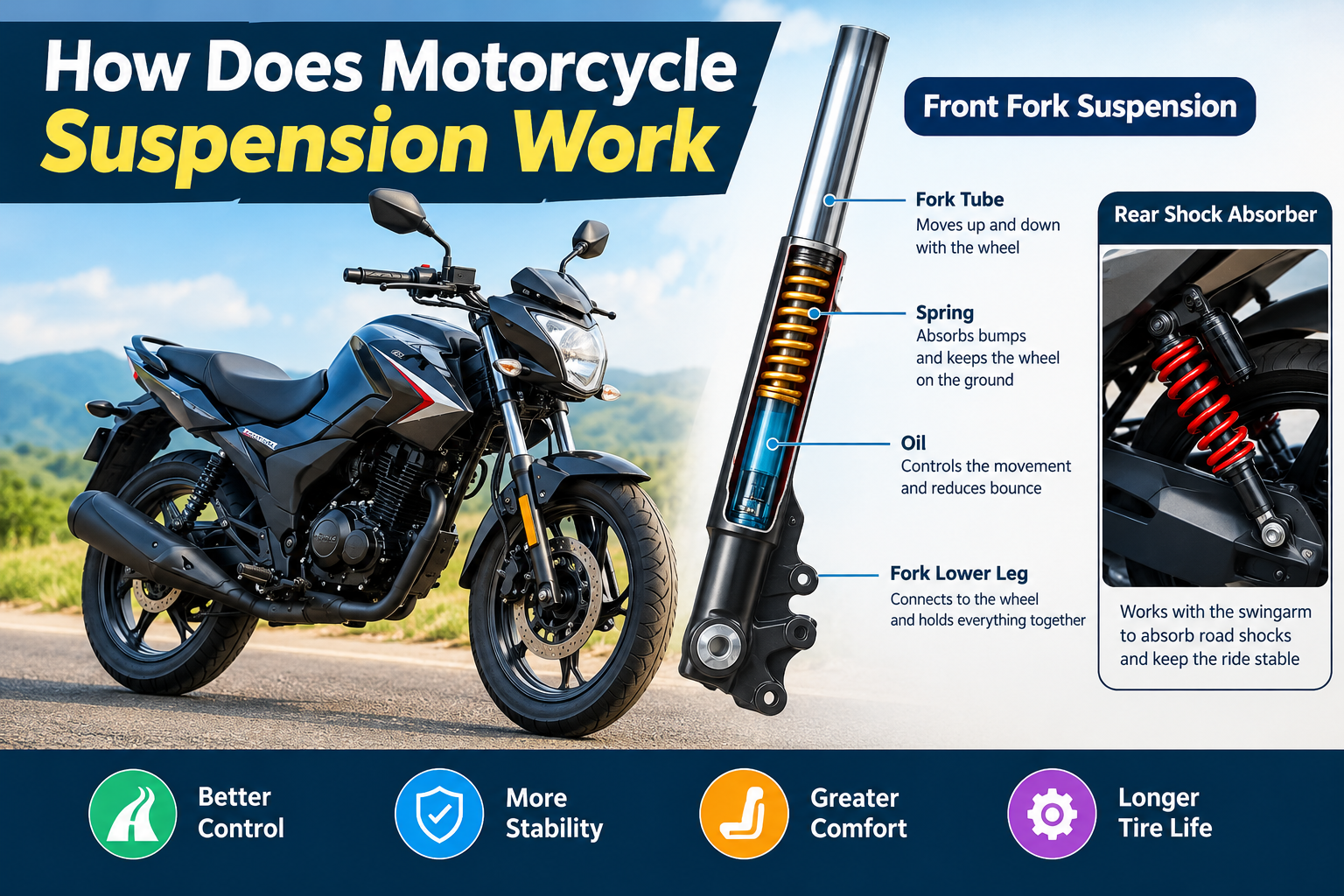
The suspension absorbs this movement through a spring and a damping mechanism. The spring compresses under the impact, helping reduce the force transferred to the rider and motorcycle frame. The damping mechanism controls how quickly the spring compresses and returns to its normal position.
After the wheel passes the obstacle, the spring expands and helps the wheel return toward its normal position. Damping prevents the suspension from bouncing repeatedly after the impact.
The same basic process happens at the rear wheel. The front and rear suspension systems respond to road conditions independently, although their movements affect the motorcycle’s overall balance.
In my view, this combination of spring action and damping is what makes suspension so important. A spring alone cannot provide proper control because it may continue bouncing after every bump. Damping helps settle the motorcycle and maintain a more predictable ride.
Main Components of Motorcycle Suspension
1. Suspension Springs
Springs support the motorcycle’s weight and absorb energy when the wheels encounter bumps. They compress when a force pushes the wheel upward and expand when that force decreases.
Most conventional motorcycle suspension systems use coil springs. The spring rate determines how much force is required to compress the spring by a certain distance.
A softer spring may provide a comfortable ride over smaller bumps, but it can compress too easily under heavy loads. A stiffer spring may provide better support for heavier riders or aggressive riding, but it can feel harsh when poorly matched to the motorcycle and road conditions.
Choosing the correct spring setup is important because comfort and control depend on how well the suspension supports the rider, passenger, and luggage.
2. Damping System
Damping controls the movement of the suspension spring. In many motorcycle suspension systems, damping is provided by oil flowing through small passages and valves inside the fork or shock absorber.
When the suspension compresses, the damping mechanism resists the movement. When it extends, the mechanism controls how quickly it returns.
Compression damping affects how the suspension responds when it is pushed inward. Rebound damping controls how quickly it extends after compression.
If damping is too weak, the motorcycle may bounce several times after hitting a bump. If damping is too strong, the suspension may struggle to respond quickly to repeated road imperfections.
Proper damping helps the tyres maintain contact with the road and improves the rider’s confidence.
3. Front Forks
Front forks connect the front wheel to the motorcycle frame through the steering assembly. They allow the front wheel to move vertically while the rider steers the motorcycle.
Most everyday motorcycles use telescopic forks. These typically consist of sliding metal tubes, internal springs, damping components, and fork oil.
When the front wheel encounters a bump, the forks compress to absorb the impact. They then extend in a controlled manner as the wheel moves away from the obstacle.
Front suspension also plays an important role during braking. When a rider applies the front brake, weight transfers toward the front wheel, causing the forks to compress. This is normal, although excessive diving may indicate unsuitable suspension settings, worn components, or a design characteristic that needs attention.
4. Rear Shock Absorbers
The rear suspension absorbs impacts from the rear wheel and supports the motorcycle’s weight. Most motorcycles use a swingarm that allows the rear wheel to move relative to the frame.
A shock absorber connects the swingarm to the motorcycle frame, directly or through a linkage system. It normally contains a spring and damping mechanism.
Some motorcycles have two rear shock absorbers, one on each side. Others use a single rear shock, which is often called a monoshock.
Rear suspension is especially important when carrying a passenger or luggage. Additional weight changes how much the suspension compresses, so a motorcycle with adjustable preload can often be adapted to different loads.
5. Swingarm and Linkage
The swingarm supports the rear wheel and allows it to move up and down. Its pivot point connects it to the motorcycle frame.
Some motorcycles also use a linkage system between the swingarm and rear shock absorber. This arrangement changes the mechanical leverage as the suspension moves.
A well designed linkage can help provide a suitable balance between initial softness and increased support deeper in the suspension travel. However, not every motorcycle uses a linkage system.
Different Types of Motorcycle Suspension
Motorcycle suspension designs vary according to price, performance, and intended use.
Telescopic Front Suspension
Telescopic forks are among the most common suspension systems on motorcycles. They are relatively straightforward, compact, and practical for daily riding.
They are found on many commuter bikes, standard motorcycles, and sports models. Some use conventional damping systems, while more advanced versions offer improved adjustability and performance.
Upside Down Forks
Upside down forks, also known as inverted forks, reverse the arrangement of conventional telescopic forks. The larger outer sections are generally positioned at the top, while the narrower sections connect closer to the front wheel.
This design can provide greater structural rigidity and help reduce unwanted flex during hard braking and cornering. Upside down forks are common on performance oriented motorcycles, although their presence does not automatically mean a bike has better suspension in every situation.
Twin Rear Shock Suspension
Twin shock suspension uses two separate rear shock absorbers. This setup is common on commuter motorcycles, classic bikes, and some touring models.
Its straightforward construction makes it practical for many everyday applications. However, performance depends on the quality of the shocks, their spring rates, damping, and overall design.
Monoshock Suspension
A monoshock system uses a single rear shock absorber. It can be installed directly between the frame and swingarm or connected through a linkage system.
Many modern motorcycles use monoshock suspension because it allows flexible packaging and can offer good handling characteristics. Its performance still depends on proper design, adjustment, and maintenance.
Air Suspension
Some specialized motorcycles use air assisted or air spring suspension systems. These systems use pressurized air to support the load and adjust the suspension characteristics.
Air suspension is not as common as conventional coil spring suspension on ordinary commuter motorcycles. It is more often associated with particular touring, custom, or specialized applications.
Why Motorcycle Suspension Is Important
A good suspension system improves several aspects of motorcycle performance.
First, it increases riding comfort by reducing the impact of potholes, broken road surfaces, and uneven pavement. This is particularly useful for people who travel long distances or regularly ride on rough roads.
Second, suspension improves handling. When the wheels remain in better contact with the road, the rider has a more consistent response during steering, braking, and acceleration.
Third, suspension supports stability. Poorly controlled bouncing can make a motorcycle feel unsettled, especially when travelling over repeated bumps.
It also helps reduce fatigue. A suspension system that works correctly limits the amount of repeated impact transferred to the rider’s hands, back, and body.
Finally, suitable suspension settings can help the tyres maintain consistent contact with the road, supporting traction and predictable motorcycle behaviour.
However, suspension cannot compensate for unsafe speeds, worn tyres, poor braking technique, or dangerous road conditions. Safe riding still depends on the rider’s decisions and the condition of the entire motorcycle.
Common Signs of Motorcycle Suspension Problems
Recognizing suspension problems early can help prevent further damage and improve riding safety.
One common sign is excessive bouncing after crossing a bump. This may indicate weak damping or worn shock absorbers.
Another warning sign is oil leaking from the front forks or rear shock absorber. Fork oil leakage can reduce damping performance and may contaminate the front brake, creating an additional safety risk.
A motorcycle that feels unusually harsh over small bumps may have unsuitable settings, incorrect tyre pressure, damaged components, or suspension parts that are binding.
Excessive front end diving during braking can result from the suspension design, unsuitable spring or damping settings, or worn components. It should be assessed in context rather than automatically treated as a fault.
Unusual knocking sounds, uneven tyre wear, or a rear end that feels unstable can also indicate a problem. These symptoms may have causes outside the suspension system, so a proper inspection is important.
If the motorcycle suddenly becomes difficult to control, develops a significant oil leak, or shows signs of structural damage, stop riding and arrange a professional inspection.
How to Maintain Motorcycle Suspension
Regular maintenance helps motorcycle suspension perform as intended.
Start by checking the front forks and rear shock absorbers for visible oil leaks, damaged seals, corrosion, or bent components. Keep exposed fork tubes clean so dirt does not damage the seals.
Follow the motorcycle manufacturer’s service schedule for fork oil replacement and suspension inspections. Fork oil can deteriorate over time, and worn internal components may affect damping performance.
Check tyre pressure regularly because incorrect pressure can change how bumps feel and influence handling. Tyre pressure should follow the manufacturer’s recommendations for the motorcycle and load.
If the motorcycle has adjustable suspension, learn what each adjustment does before changing it. Preload changes the spring’s initial compression and helps set sag, but it does not directly change the spring rate. Compression and rebound adjustments affect damping where those controls are provided.
Avoid making several changes at once. Small, recorded adjustments make it easier to identify what improves the ride.
Finally, have damaged or worn suspension components inspected by a qualified mechanic. Suspension work may involve high spring forces and specialized tools, so repairs should be performed safely.
Conclusion
Understanding how motorcycle suspension works helps riders appreciate why this system matters so much. Springs absorb energy from bumps, damping controls suspension movement, front forks manage the front wheel, and rear shocks work with the swingarm to support the rear wheel.
The best suspension is not necessarily the stiffest or the most expensive. It is the system that suits the motorcycle, the rider’s weight, the road conditions, and the intended use.
From my perspective, checking suspension condition should be part of regular motorcycle maintenance, just like inspecting tyres, brakes, and engine oil. A properly maintained suspension system can make daily commuting more comfortable and help the motorcycle respond more predictably on the road.
Whether you ride a small commuter bike or a high performance motorcycle, paying attention to suspension condition is a practical way to support comfort, stability, and safer riding.