Introduction
When choosing a motorcycle, most people focus on engine power, fuel average, design, and price. However, one important factor that deserves attention is the engine cooling system. Motorcycle air cooled vs liquid cooled engines is a common topic among riders because both systems have their own advantages and disadvantages.
In my opinion, understanding the difference between air cooled and liquid cooled motorcycle engines can help riders make a better buying decision. The cooling system affects how an engine manages heat, how consistently it performs, and how much maintenance it requires. It can also influence the overall cost of owning a motorcycle.
Air cooled engines are commonly associated with simple and affordable motorcycles, while liquid cooled engines are often found in performance oriented bikes. However, the better option depends on how you ride, the weather conditions in your area, your budget, and the type of motorcycle you need.
In this article, I will explain how both cooling systems work, compare their performance, maintenance, fuel efficiency, and cost, and discuss which one is better for everyday riding.
What Is an Air Cooled Motorcycle Engine?
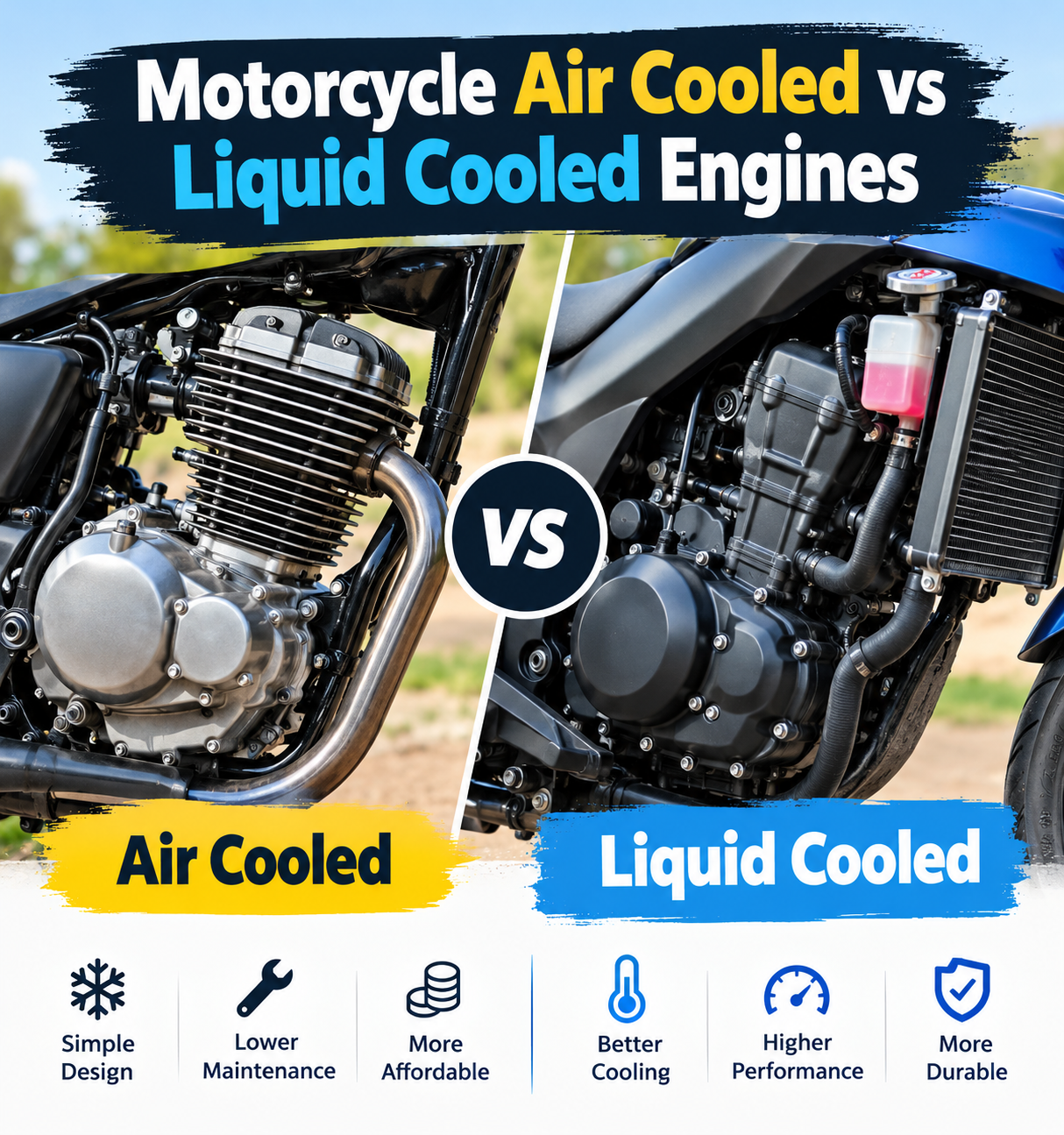
An air cooled motorcycle engine uses the surrounding air to remove excess heat from the engine. Instead of circulating coolant through passages inside the engine, this system relies on airflow and specially designed metal fins.
If you look closely at the engine of an air cooled motorcycle, you will notice several metal ridges around the cylinder and cylinder head. These are called cooling fins. They increase the surface area of the engine, allowing heat to transfer into the surrounding air more effectively.
When the motorcycle moves, air flows across these fins and carries heat away from the engine. Some motorcycles also benefit from natural airflow when running at low speeds, although cooling performance generally improves when more air passes over the engine.
One of the biggest advantages of an air cooled motorcycle engine is its simple design. It does not require a radiator, coolant pump, or network of coolant hoses. This reduces the number of components that may need repair or replacement.
For everyday riders who want a practical motorcycle for commuting, an air cooled engine can be a sensible choice. It is particularly attractive when affordability, straightforward maintenance, and long term ownership costs are important considerations.
However, air cooling has limitations. The engine’s temperature depends heavily on airflow, outside temperature, engine load, and riding conditions. During extended traffic jams or demanding rides in hot weather, the engine may struggle to remove heat as efficiently as a well designed liquid cooling system.
What Is a Liquid Cooled Motorcycle Engine?
A liquid cooled motorcycle engine uses coolant to absorb heat from the engine and transfer it to a radiator. The radiator then releases that heat into the surrounding air.
This system usually includes a radiator, coolant passages, a water pump, hoses, a thermostat, and a cooling fan. The exact design varies depending on the motorcycle model.
As the engine operates, coolant circulates through passages around important engine components. It absorbs excess heat and carries it to the radiator. Air passing through the radiator removes the heat before the coolant returns to the engine.
Many liquid cooled motorcycles also have an electric cooling fan. The fan helps move air through the radiator when the motorcycle is stationary or moving slowly, such as in heavy city traffic.
The main advantage of liquid cooling is better temperature control. By maintaining a more consistent operating temperature, the system can help an engine deliver reliable performance under changing riding conditions.
Liquid cooled engines are common in many modern sport bikes, touring motorcycles, and higher performance models. They are especially useful when an engine produces substantial heat or must maintain consistent performance during demanding rides.
However, liquid cooling adds complexity. Coolant must be checked and replaced according to the manufacturer’s recommendations, and components such as the radiator, pump, hoses, and fan may eventually require attention.
Motorcycle Air Cooled vs Liquid Cooled Engines: Main Differences
The most important difference between these two systems is how they remove heat. Air cooled engines release heat directly into the surrounding air, while liquid cooled engines use circulating coolant and a radiator.
Here is a simple comparison.
| Feature | Air Cooled Engine | Liquid Cooled Engine |
|---|---|---|
| Cooling method | Airflow over cooling fins | Coolant and radiator |
| Design | Simpler | More complex |
| Initial cost | Often lower | Often higher |
| Maintenance | Generally simpler | Requires coolant system maintenance |
| Temperature control | More dependent on riding conditions | Generally more consistent |
| Traffic performance | Can experience greater heat buildup | Usually manages heat more effectively |
| Engine weight | Often lighter overall | Cooling components add weight |
| Repair costs | Often lower for cooling related repairs | Can be higher if cooling components fail |
| Performance suitability | Suitable for many everyday motorcycles | Well suited to demanding and high performance use |
These are general comparisons rather than absolute rules. Actual performance, reliability, and ownership costs depend on the motorcycle’s design, engine size, build quality, and maintenance history.
Which Engine Provides Better Performance?
When comparing air cooled vs liquid cooled motorcycle engines, performance is one of the biggest considerations.
Liquid cooled engines generally have an advantage when consistent performance is required under demanding conditions. Their cooling systems help maintain a more stable operating temperature, which can support precise engine design and reliable power delivery.
This is particularly important for motorcycles that are ridden at high speeds for extended periods, carry heavy loads, or use engines designed to produce substantial power.
Air cooled engines can also provide dependable performance. Many are designed for moderate power output and everyday riding rather than maximum speed. For commuting, short trips, and relaxed cruising, an air cooled engine may provide everything a rider needs.
I believe it is important not to judge a motorcycle only by its cooling system. Engine displacement, tuning, gearing, weight, and overall design also affect acceleration and top speed. A liquid cooled motorcycle is not automatically faster than every air cooled motorcycle.

Which Cooling System Is Better for Hot Weather?
Hot weather makes engine cooling especially important. In countries such as Pakistan, where summer temperatures can become very high, riders should consider how their motorcycles handle heat during everyday use.
Air cooled engines depend heavily on airflow. When a motorcycle travels at a reasonable speed, air passes across the cooling fins and helps remove heat. However, when the motorcycle remains stationary in traffic, airflow decreases and engine temperatures can rise.
Liquid cooled motorcycles have an advantage in these conditions because the coolant circulates through the engine and the radiator fan can help remove heat at low speeds.
Nevertheless, liquid cooling does not make a motorcycle immune to overheating. A blocked radiator, low coolant level, faulty fan, or damaged water pump can cause serious problems.
For riders who frequently travel through crowded cities or ride long distances in hot weather, I would generally consider a well maintained liquid cooled motorcycle a strong option. For lighter daily use, a properly designed air cooled engine can still be practical and reliable.
Which Engine Is More Fuel Efficient?
Fuel efficiency is another important factor when buying a motorcycle. Many riders want good mileage because fuel costs can represent a significant part of their monthly transport budget.
Air cooled motorcycles are often available with smaller engines and relatively simple designs. These characteristics can contribute to affordable daily transportation, particularly when the motorcycle is designed for fuel economy.
Liquid cooled engines can also be very fuel efficient. Their ability to maintain a more stable operating temperature can help engineers optimize combustion and performance. However, the cooling system itself does not guarantee better mileage.
In real world riding, fuel consumption depends on engine size, tuning, riding speed, traffic, tyre pressure, maintenance, and acceleration habits.
If fuel economy is your main priority, compare the actual mileage of the motorcycle models you are considering instead of choosing solely by cooling system. A small, economical liquid cooled motorcycle may use less fuel than a larger air cooled model.
Maintenance and Repair Costs
Maintenance is one area where air cooled engines often have an advantage. Their cooling systems contain fewer components, so there are fewer cooling related parts to inspect or repair.
Owners should still follow the manufacturer’s maintenance schedule. Engine oil changes, air filter cleaning, spark plug inspection, valve clearance checks, and general servicing remain important. Cooling fins should also be kept reasonably clean so that airflow is not restricted.
Liquid cooled motorcycles require these regular engine maintenance tasks as well. In addition, riders need to check coolant levels, inspect hoses for leaks, and maintain the radiator and cooling fan.
Coolant must be replaced at the intervals specified in the owner’s manual. Using the correct coolant is important because unsuitable fluids can cause corrosion or damage cooling system components.
If a radiator develops a leak or a water pump fails, repairs can be more expensive than many routine air cooled engine repairs. On the other hand, a properly maintained liquid cooled engine can provide excellent service for many years.
From my perspective, the best choice depends on whether you prefer a simpler motorcycle with fewer cooling components or are comfortable maintaining a more complex system for its potential performance benefits.
Which Engine Lasts Longer?
There is no universal answer to whether air cooled or liquid cooled motorcycle engines last longer. Engine lifespan depends on design quality, regular maintenance, lubrication, operating temperature, and riding habits.
An air cooled engine can last a long time when it is used within its intended limits and serviced regularly. Its straightforward design can also make certain repairs easier.
A liquid cooled engine can achieve a similarly long service life. By controlling operating temperatures more consistently, its cooling system can help reduce excessive heat related stress when functioning correctly.
However, liquid cooled engines have additional components that can fail. If a cooling system problem is ignored, the engine may overheat and suffer serious damage.
For both types, checking engine oil, responding to unusual noises, watching for leaks, and following the service schedule are essential. The condition and maintenance history of a used motorcycle are often more important than whether its engine is air cooled or liquid cooled.
Which Engine Is Better for Daily Commuting?
For daily commuting, the right cooling system depends on your route and budget.
An air cooled motorcycle can be an excellent choice for riders who travel short distances, use moderate engine speeds, and want an affordable motorcycle with straightforward maintenance. It may be especially suitable for routine travel to work, college, shops, or nearby locations.
A liquid cooled motorcycle can be a better fit for riders who regularly face heavy traffic, travel long distances, or want stronger performance from a more demanding engine.
Before buying, I recommend considering the purchase price, fuel consumption, availability of spare parts, servicing costs, and the quality of the local repair network.
A motorcycle that is easy to maintain in your area may be a better long term investment than a more advanced model whose parts and servicing are difficult to find.
Final Verdict: Air Cooled vs Liquid Cooled Motorcycle Engines
Both air cooled and liquid cooled motorcycle engines have useful advantages. Neither system is automatically the best choice for every rider.
Air cooled engines are attractive because of their simple design, generally lower maintenance complexity, and affordability. They work well for many everyday motorcycles and are a sensible option for riders who prioritize practical transportation.
Liquid cooled engines offer more consistent temperature control and are often better suited to demanding riding, prolonged high engine loads, and performance focused motorcycles. Their additional components require maintenance, but the benefits can be worthwhile for the right rider.
If I were choosing a motorcycle mainly for affordable daily commuting, I would pay close attention to reliability, fuel economy, spare parts, and servicing costs before deciding. If I expected to ride long distances regularly or wanted a performance oriented motorcycle, I would give liquid cooling serious consideration.
Ultimately, the best motorcycle is the one that matches your riding conditions, budget, and maintenance preferences. Understanding the difference between air cooled and liquid cooled engines helps you make a more informed decision and enjoy a safer, more dependable riding experience.
Frequently Asked Questions
1. Is an air cooled motorcycle engine better than a liquid cooled engine?
An air cooled engine may be better for riders who want simplicity and lower maintenance complexity. A liquid cooled engine is generally better at controlling temperature under demanding conditions. The right option depends on how the motorcycle will be used.
2. Do liquid cooled motorcycle engines require more maintenance?
They require additional cooling system maintenance, including coolant checks, coolant replacement, and radiator inspections. However, the overall maintenance requirements depend on the motorcycle model and the manufacturer’s service schedule.
3. Can an air cooled motorcycle overheat in traffic?
Yes. Limited airflow, high outside temperatures, and prolonged idling can increase engine heat. Riders should follow the owner’s manual and avoid continuing to operate a motorcycle if it shows signs of overheating.
4. Are liquid cooled motorcycles more expensive?
They are often more expensive because their cooling systems contain additional components. However, prices vary according to the motorcycle’s brand, engine size, features, and overall design.
5. Which motorcycle cooling system is better for long rides?
Liquid cooling is often advantageous for long rides involving sustained engine loads or hot conditions because it helps maintain a more consistent operating temperature. A properly designed air cooled motorcycle can also handle long journeys when used within its intended limits and maintained correctly.